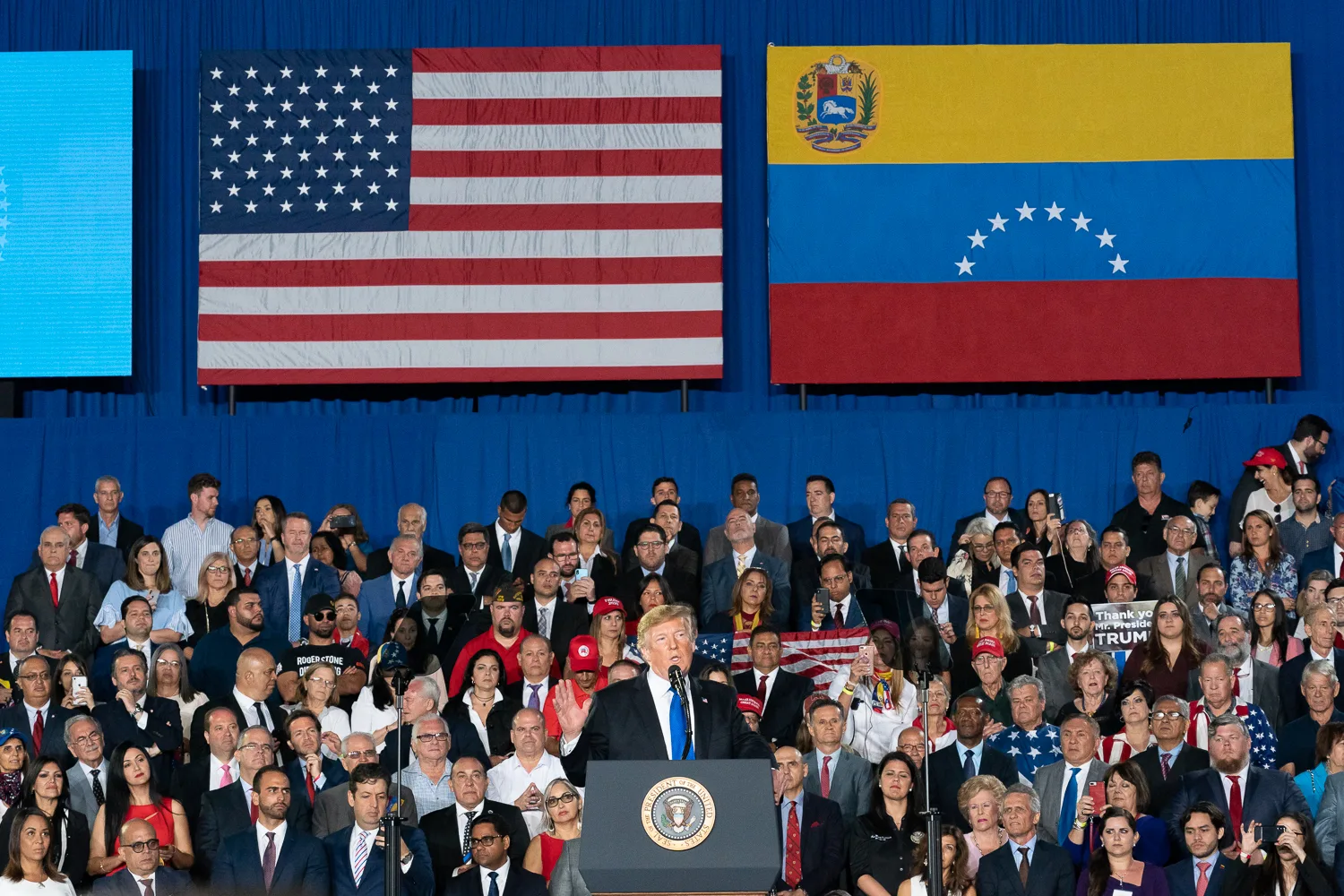
President Trump ordering missiles onto Caribbean boats, a socialist leader talking about piracy, and a Nobel laureate who slipped out on a fishing skiff — the new Venezuela–U.S. standoff feels less like Cold War and more like a collision between a navy, a shadow fleet, and a government in waiting.
By Carlos Taylhardat | 3 Narratives News | December 18, 2025
Intro
On a dark December night in the eastern Pacific, a U.S. drone tracked a small boat until it was just a smudge of heat on water. Then the video flashed white, and the vessel disappeared in an expanding circle of spray. Hours later, in another part of the world, María Corina Machado, the Venezuelan opposition leader who had once been banned from travelling, stepped off a commercial flight in Oslo, wrapped in a winter coat.
Between those two images — the boat and the arrival hall — sits the new front line of the Venezuela–U.S. confrontation. President Donald Trump says he is in an “armed conflict” with narco-terrorists and a regime that “stole our oil.” Nicolás Maduro says Washington has turned the Caribbean into a war zone and hijacked a tanker in international waters. Machado and Edmundo González say the real story is simpler: Venezuelans elected a new government, and the world is now deciding whether to treat it as a fantasy or as a fact. In the online version of this story, a simple map tracing the main strike zones and tanker routes helps show how close that new naval chessboard runs to ordinary shipping lanes.
A Phone Call, 26 Strikes, and a Seized Tanker
At the center of this standoff is a brief phone call that almost nobody heard, and everyone is now trying to interpret.
In late November, according to reporting by Reuters and the Guardian, Trump spoke directly with Maduro for less than fifteen minutes. The Venezuelan president has described it as “respectful and cordial,” a possible opening. Trump’s version, relayed by U.S. officials, is harsher: he rejected Maduro’s pleas for sanctions relief and told him he had a short deadline to leave Venezuela with his family for a country of his choice. When that deadline passed, Trump announced that Venezuelan airspace was closed and hinted that a broader confrontation was already underway.
At sea, the shift was already visible. Since September, the U.S. military has carried out a campaign of lethal strikes on small vessels in the Caribbean and eastern Pacific, saying they are used by drug traffickers linked to Venezuelan and regional cartels. As of December 18, U.S. officials acknowledge 26 strikes and at least 99 people killed, figures reported by outlets including the Associated Press and compiled in public overviews of the campaign. Trump has framed this as an “armed conflict” with drug cartels; Human Rights Watch, U.N. experts and legal scholars writing at Just Security have warned that the operations may amount to arbitrary killings in international waters rather than lawful wartime targeting.
A week ago, the war moved from fast boats to a lumbering oil tanker. Armed U.S. personnel descended from a helicopter onto the Skipper, a sanctioned vessel off Venezuela’s coast, and seized control. According to court filings and reporting by Reuters, the ship had loaded roughly 1.8 million barrels of Venezuelan crude in violation of U.S. sanctions and was bound largely for Cuba. The U.S. warrant describes the tanker as part of a sanctions-evading “shadow fleet”; a PBS NewsHour explainer calls the seizure a new phase in Washington’s crackdown. Attorney General Pam Bondi has presented the raid as a lawful execution of a seizure warrant. Cuba and Venezuela, by contrast, have denounced it as “piracy” and “maritime terrorism,” language used in Cuban foreign ministry statements.
International-law specialists are divided. A recent analysis by two maritime-law scholars on Just Security argues that while boarding the ship may fit established law-of-the-sea rules, the full seizure “raises unsettled questions” about how far a country can project its domestic sanctions into international waters. Others, including Alberto Coll of DePaul University in a televised interview, have defended the operation as a necessary intervention against what they see as state-facilitated criminal activity.
Days later, Trump went further, ordering a “blockade” of sanctioned tankers in and out of Venezuela. Navy vessels and aircraft now shadow a shadow fleet: dozens of sanctioned ships that have made a business out of shuttling Venezuelan crude under flags of convenience, often with their transponders turned off.
Somewhere in that same sea, earlier this month, a small wooden skiff carrying the woman many Venezuelan opposition supporters call “la flaca,” the skinny one, fought heavy waves on its way to Curaçao. Her name was not on the manifest.
María Corina Machado’s Escape: The Hybrid Rescue
By the time Machado decided to leave Venezuela to attend the Nobel Peace Prize ceremony in Oslo, she had spent months in hiding under a travel ban, after backing Edmundo González as the opposition’s unity candidate in the disputed July 2024 election.
The mission to get her out, pieced together from reporting in the Guardian, the Washington Post, NPR (and in later accounts by the Nobel committee), reads like a political thriller. Disguised with a wig and plain clothes, she left a safehouse near Caracas and crossed a string of military checkpoints by road to a small fishing community on the Caribbean coast. Late at night, she boarded a battered fishing skiff with a tiny crew and set off into rough seas toward an offshore rendezvous near Curaçao.
In the middle of the journey, the boat reportedly lost GPS and communications and drifted in high waves. Onshore, the extraction team — led by Grey Bull Rescue, a U.S.-based group founded by former special forces operator Bryan Stern — briefly feared her boat had been lost or intercepted. Eventually the skiff re-established contact, linked up with another vessel, and reached Curaçao. From there she flew to Miami and then to Oslo, arriving just after her daughter had accepted the Nobel medal on her behalf.
Stern and Grey Bull say the mission was funded by private donors, not by Washington. But in Norway, Machado acknowledged that a state actor had quietly cleared invisible obstacles out of her way. “We did get support from the United States government to get here,” she told reporters at a press conference in Oslo, in comments carried by AFP and outlets such as Arab News and France 24.
Given the U.S. campaign against suspected drug boats in the same waters, that support almost certainly included deconfliction: making sure that a small, unmarked Venezuelan fishing craft carrying a banned opposition leader would not be mistaken for the 27th target in an expanding maritime war.
Her escape completes a pattern. Earlier this year, members of her team and relatives walked out of the Argentine ambassador’s residence in Caracas under an international deal that eventually landed them in the United States. Now the leader herself has joined the exile circuit. The question that hangs over all of this is whether she and González are being prepared as a government in waiting — and, if so, what that government would actually do with the country Trump says “stole our oil.”
Narrative 1: The Liberation Story — Trump’s Pressure, González’s Oath, Machado’s “Popular Capitalism”
Inside the story told by Trump’s supporters and by the Venezuelan opposition around Machado and González, the events of this winter are not a random escalation. They are the closing chapter of an election that already happened and a transition that has been blocked by force.
In this worldview, the July 2024 vote ended with a clear verdict: the Venezuelan people chose Edmundo González as president and backed Machado as the architect of a post-Maduro future. The “usurper,” as opposition leaders and some foreign governments call Maduro, refused to step aside; the state apparatus went after activists, and the winners were driven into exile or hiding. Reports by independent observers and a subsequent Human Rights Watch investigation describe a pattern of killings, detentions and enforced disappearances after the vote.
González, a soft-spoken former diplomat, has been remarkably consistent in how he describes his first days in office — whenever he gets them. “We are committed to carrying out a transition where we guarantee the freedom of political prisoners, the return of exiles and of all Venezuelans who have left and wish to return,” he told Reuters in 2024, when he first emerged as the unity candidate. A year later, already in exile in Spain, he told the same outlet that he was convinced he would return “to be sworn in as president.”
Machado’s language is sharper. She talks about a “threshold of freedom,” about a regime whose “long and violent abuse of power is ending,” and about a country that can move overnight from hunger lines to investment pitches if it can first get rid of the men with guns.
Her economic philosophy, laid out in a document she calls the Freedom Manifesto and in essays and interviews cited by outlets such as The Economist, is built on three pillars: inviolable civil rights, secure property, and a state that regulates instead of owning. “A renewed Venezuela will guarantee the right to own property, and to reclaim what was stolen,” the manifesto reads. “Property is not a privilege of the elite; it is a fundamental right, the physical manifestation of a person’s lifetime of labor and ingenuity.” The state, she argues, must “provide the conditions to create a free and competitive economy” rather than “unduly interfering” in it.
To her supporters, this is not code for a cold, technocratic liberalism but for what she has long called “popular capitalism” — a model in which ordinary Venezuelans become shareholders and owners in an economy now dominated by a bankrupt state and opaque military enterprises, a term she was already using more than a decade ago in interviews reported by Venezuelanalysis.
In Oslo this month, she reached for a bolder phrase. “Venezuela will become the envy of the planet,” she told an audience, “because we will bring immense investments that will translate into jobs, goods, and services.” The diaspora of some eight million Venezuelans scattered across the Americas and Europe, she said, would be part of that rebuilding.
In a Narrative 1 scenario, in which Trump’s pressure and international diplomacy produce a negotiated exit for Maduro sometime in early 2026, the transition would move quickly. González returns from Spain, perhaps under international protection, to be sworn in as president. Machado, now a Nobel laureate with a signed manifesto and a global network, becomes vice president and chief architect of economic reform. Their first acts are meant to send strong signals: immediate release of political prisoners, legal guarantees for returning exiles, and emergency legislation to protect property rights and independent courts.
For the United States, this narrative offers redemption and repayment. Two U.S. oil majors — ExxonMobil and ConocoPhillips — saw multibillion-dollar projects swept up in Venezuela’s nationalizations under Hugo Chávez, then spent years in arbitration. Tribunals ordered Caracas to pay roughly $1.6 billion to Exxon and about $8.7 billion plus interest to ConocoPhillips over the expropriation of Orinoco Belt assets. Much of that money is still tied up in legal and political limbo.
A González–Machado government, desperate for investment and aligned with the idea that “what was stolen” must be compensated, would have strong incentives to settle. That could mean offering cash and long-term oil revenues, plus equity in new joint ventures, in exchange for clearing the slate. U.S. service companies that scaled back under sanctions would scramble back in. Chevron, already operating under narrow U.S. waivers, would be first in line to expand. For Trump’s supporters, this is what it means to “get our oil back”: not seizing wells but rewriting contracts, with Caracas now eager instead of hostile.
On the security side, the war on drug boats becomes a partnership rather than a unilateral campaign. Instead of missiles in the dark, U.S. forces work with a friendly Venezuelan Navy and a remade police and intelligence apparatus to chase the same networks Trump currently calls “narco-terrorists,” with shared rules of engagement and, at least in theory, fewer anonymous bodies in the sea.
Economists looking at the same scenario are both intrigued and cautious. In a recent “By Invitation” column, Machado herself argued in The Economist that a democratic transition could unlock investment close to $2 trillion over the coming decade. Independent analysts quoted in policy briefs and think-tank reports have welcomed the scale of that ambition but warn that without strong institutions and safeguards, a rapid opening could repeat Latin America’s familiar pattern of boom-and-bust, with the gains captured by a narrow elite.
Narrative 2: The Siege Story — Maduro’s War of Attrition Against a Northern Empire
Inside the Maduro government’s narrative, the story looks almost inverted.
In that telling, Trump has rebranded a sanctions policy into open warfare, using drones and naval commandos to enforce U.S. economic will on the high seas. The Skipper was not a legitimate target but a commercial tanker in international waters, seized because it carried oil destined for Cuba, a political ally Washington has wanted to isolate for sixty years. The step from confiscating cargo to physically boarding ships feels, in this argument, like a step back toward gunboat diplomacy.
Within Venezuela, this narrative lands in a country that has been told for years that it is under economic siege. Maduro speaks of “imperialist aggression,” points to the long list of U.S. sanctions on the state oil company PDVSA and senior officials, and tells his supporters that every fuel shortage, every blacked-out neighborhood, is an expression of Washington’s desire to choke the Bolivarian project.
The boat strikes become another chapter in this siege. On paper, the targets are “narco-terrorists.” On Venezuelan television, they are anonymous Latin American men blasted out of the water without charges or trials. Human rights groups and legal scholars — including U.N. special rapporteurs who warned in a November statement that unprovoked attacks on vessels in international waters may amount to extrajudicial executions — argue that the campaign blurs the line between law enforcement and war. Analyses in venues like Just Security and PBS NewsHour echo that concern, questioning whether the legal thresholds for lethal force at sea have been met.
Maduro’s diplomats have framed the tanker seizure as a precedent that should alarm not just Caracas but every country whose exports could someday come under U.S. sanctions. If Washington can declare a commercial ship illegal and seize it by force — while arguing that its own domestic warrants apply beyond its territorial waters — what stops it from doing the same to Russian, Iranian or even Chinese vessels?
In this Narrative 2 view, Machado’s journey is not a heroic escape but an extraction engineered by a foreign power that has decided she is its preferred leader. The dramatic details — the wig, the checkpoints, the threatened boat in high seas — become proof that the United States is willing to circumvent Venezuelan institutions entirely when it suits its interests. Her own acknowledgment of U.S. “support” is waved as evidence that the opposition’s leadership has become, at best, a partner in regime change and, at worst, a client.
Edmundo González, in this telling, is not a president in waiting but a former diplomat now lobbying from Spain with the backing of Western governments. His pledge to free political prisoners and bring exiles home is read not as a promise of reconciliation but as a coded threat that today’s officials will face trials tomorrow, possibly under foreign-funded transitional-justice mechanisms.
For Caracas, the arbitration awards to ExxonMobil and ConocoPhillips are part of the same picture. From the government’s perspective, Chávez’s nationalizations were a sovereign decision, taken after some companies refused to accept new terms. The fact that international tribunals awarded more than $10 billion in compensation is seen not as justice but as a warning that foreign investors can drag a state into court for trying to reclaim its natural resources. The current attempt by those companies to collect, including in U.S. courts and through claims on Citgo, is portrayed as a long-term attempt to strip Venezuela of its overseas assets.
Layered onto this is a long memory of coups and invasions. Maduro often invokes the 2002 coup attempt against Hugo Chávez, in which a group of military officers briefly ousted the president before loyalists restored him. In the current crisis, he points to Trump’s warships off the coast and to Trump’s own references to “regime change” as proof that the United States is again trying to decide who governs in Caracas.
Seen from inside this narrative, the government’s strategy is not to cling to power for its own sake but to resist what it calls “forced regime change.” The bet is that enough countries — China, Russia, some in the Global South — will reject the precedent of a blockade and a naval seizure, even if they have little affection for Maduro himself, and will push for negotiations that protect Venezuelan sovereignty before they address Venezuelan democracy.
Narrative 3: The Silent Story — Lives Between the Tankers and the Ballot Box
Below these two stories — liberation and siege — lies a quieter one, written in remittance slips, WhatsApp calls, and ship manifests.
On the docks of Puerto Cabello and Maracaibo, sailors and oil workers are watching the Skipper episode with something like horror. Many of them have spent the last decade trapped between a state oil company that cannot pay reliably and a global market that treats Venezuelan crude as radioactive. Now they are told that some tankers may simply be taken in mid-sea, their crews detained, their cargo re-routed to U.S. ports under court orders. The risk premium on a Venezuelan voyage is no longer just financial; it is personal.
Onshore, the boat strikes blur into a more familiar fear. Along stretches of the Caribbean coast, young men have long taken risky jobs crewing small craft for smugglers, ferrying gasoline, migrants or cocaine along routes where coast guards and cartels trade shots over waves. For their families, the U.S. videos of explosions at sea are uncomfortably close to home. Some will say, with resignation, that anyone who goes out for the cartels knows the danger. Others will quietly ask what it means when a foreign military can blow up a vessel thousands of miles from its own shores, with little more than a press release afterward.
For the Venezuelan diaspora, Machado’s escape is a mirror. In Madrid, Bogotá, Santiago and Miami, exiled Venezuelans watched a woman in disguise make it out by boat while they checked their own documents: asylum claims pending, work permits expiring, children who speak more Spanish with a Colombian or Chilean accent than with the one from back home. Many of them would like nothing more than to take González and Machado at their word, to believe that a new government could offer not just safe return but jobs, schools, hospitals and a currency that holds its value.
Inside Venezuela, in barrios and small towns far from presidential palaces and Nobel ceremonies, the standoff registers as a new layer on top of old shortages. Power outages, water cuts, long queues for fuel — these are not abstractions. They are daily routines. When Maduro rails against sanctions, some families nod; when opposition leaders talk about stolen elections and expropriated assets, some nod as well, remembering the day a government inspector padlocked an old shop or factory. For them, the question is less about who sits in Miraflores and more about whether any of these outside forces — navies, arbitrations, Nobel committees — can actually make the light stay on.
And for readers outside the region, there is a quieter meta-story: the way this conflict is narrated. The same drone strike can be described as a blow against “narco-terrorists” or as a suspected war crime. The same tanker can be a legitimate target or the victim of piracy. The same manifesto can be either a blueprint for democratic renewal or a promise of shock therapy drawn from Margaret Thatcher’s textbook. Part of the work of journalism — and of projects like ours — is to lay those storylines side by side without pretending they are all equally right, but without erasing the humans caught in the middle.
For a deeper dive into how we use AI-assisted research and human judgment in stories like this, see our explainer “Truth and Lies About AI Assistance in the Newsroom” and our policy page “How 3 Narratives News Uses AI Search Assistance.”
Key Takeaways
- The current U.S.–Venezuela standoff combines Trump’s phone ultimatum to Maduro, a lethal boat-strike campaign that has killed at least 99 people, and a new naval crackdown on sanctioned oil tankers.
- María Corina Machado’s escape from Venezuela to Oslo was a privately organized but U.S.-assisted operation by sea and air, underscoring how far the opposition’s leadership has moved into exile politics.
- Narrative 1, from the opposition and pro-Trump perspective, sees a looming handover to President-in-waiting Edmundo González and Vice President Machado, with “popular capitalism,” property rights and settlement of old expropriation claims as the basis of a boom.
- Narrative 2, from Maduro’s and anti-intervention voices, frames the boat strikes and tanker seizure as illegal acts of piracy and forced regime change, with Machado’s escape as a foreign-engineered extraction rather than a purely Venezuelan drama.
- The silent story is about the people in between — sailors, coastal communities and millions of exiled and remaining Venezuelans — whose lives are shaped less by speeches than by whether electricity, salaries and safe travel ever return to something like normal.
Questions This Article Answers
- What triggered the latest escalation between the United States and Venezuela?
A short phone call in late November, in which Trump gave Maduro a deadline to leave Venezuela, set the tone. When the deadline passed, the U.S. escalated a campaign of lethal strikes on suspected drug boats and seized a sanctioned oil tanker off the Venezuelan coast, while announcing a blockade on similar vessels. - How many people have been killed in the U.S. strikes on suspected drug boats?
According to figures released by U.S. officials and summarized by major news outlets, there have been 26 known strikes on vessels in the Caribbean and eastern Pacific since September 2025, with at least 99 people killed in those operations. - What exactly happened in the María Corina Machado escape operation?
Machado, under a travel ban and in hiding, traveled in disguise from Caracas to the Caribbean coast, boarded a small fishing boat that endured rough seas and a communications blackout, rendezvoused with another vessel near Curaçao, then flew via Miami to Oslo. The mission was organized by the U.S.-based Grey Bull Rescue foundation and, according to Machado, benefited from support by the U.S. government. - What would a government led by Edmundo González and María Corina Machado try to do first?
González has promised to free political prisoners and enable the return of exiles, while Machado’s Freedom Manifesto commits to guaranteeing property rights, reclaiming what was “stolen,” and building a “popular capitalism” that relies on private investment and secure rules. In practice, that would likely mean stabilizing the currency, reopening to foreign capital, and negotiating settlements with companies whose assets were nationalized. - What is at stake for U.S. and other foreign companies if Venezuela changes government?
For U.S. oil majors like ExxonMobil and ConocoPhillips, which won arbitration awards of about $1.6 billion and $8.7 billion respectively over past expropriations, a friendly government could mean structured repayment and new business. For service firms and miners, a transition could reopen one of the world’s largest oil reserves and a major mining frontier, but under intense scrutiny over corruption, environmental damage and the legacy of past nationalizations.
Process & AI-Use Disclosure
Editor’s note: This article was reported and written by a human journalist using open-source documents, major-newsroom reporting and official records, with AI used as a research and drafting assistant. All quotations and factual claims are based on cited sources; narrative structure and interpretations are the author’s. For details on how we use AI in the newsroom, see our AI-use policy, and for corrections or updates, visit our corrections page.


