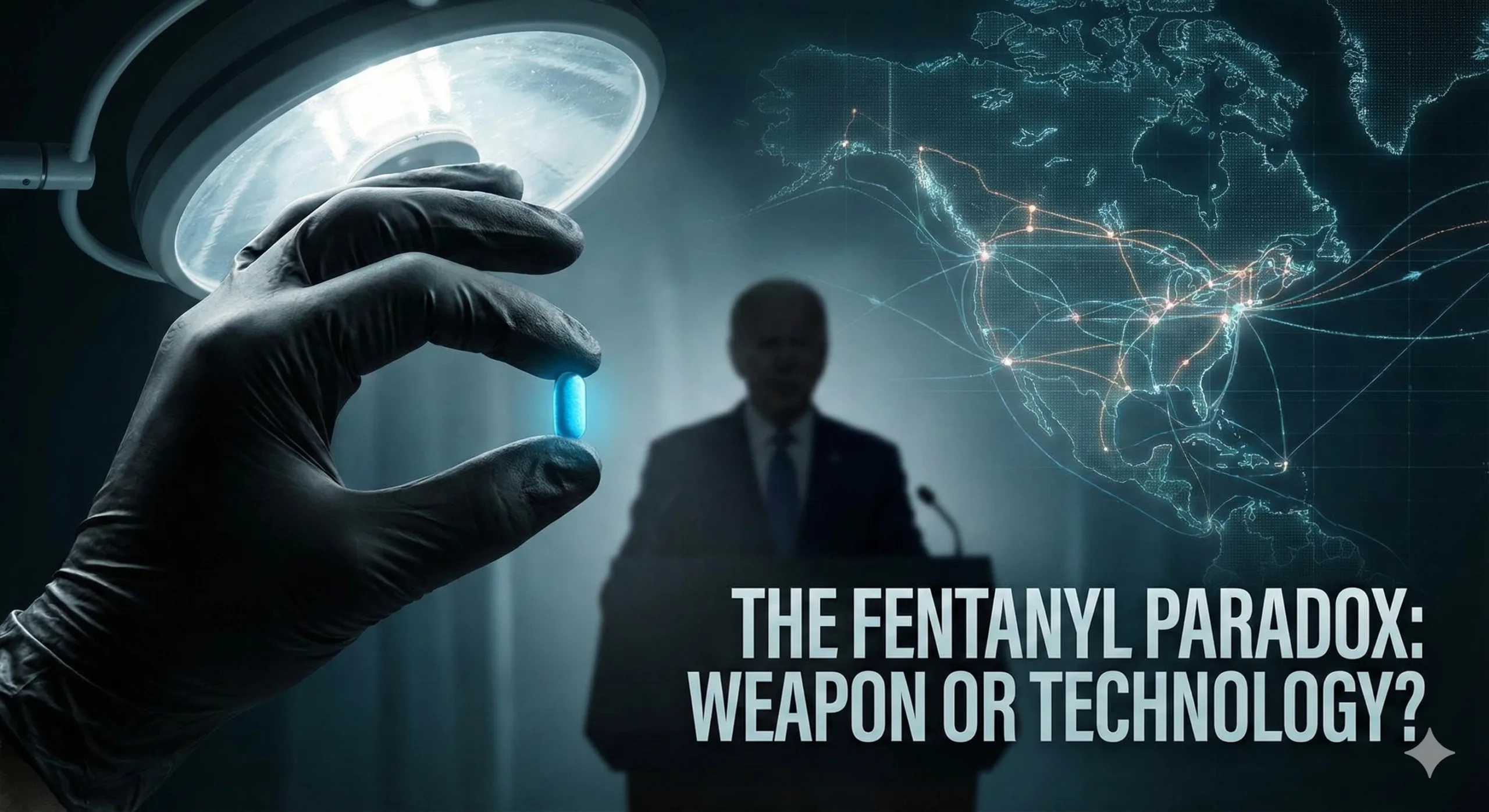
Donald Trump has just classified illicit fentanyl as a “weapon of mass destruction,” unlocking Pentagon and intelligence powers normally reserved for chemical warfare. Supporters call it long overdue, critics warn of a militarised drug war, and beneath both, communities search for an actual cure.
3 Narratives News | December 16, 2025
Intro
On a winter afternoon at the White House, Donald Trump stood at a lectern and tried to rename a drug.
“There’s no doubt that America’s adversaries are trafficking fentanyl into the United States, in part because they want to kill Americans,” he said.
“With this historic executive order I will sign today, we’re formally classifying fentanyl as a weapon of mass destruction.”
Behind him were families who had lost children, parents, siblings. In front of him, a document that does something no U.S. president has done before: it legally treats illicit fentanyl and its core precursors as a weapon, not just a narcotic, bringing them into the same legal universe as nerve agents and other chemical threats.
This is not just a tough-on-crime flourish. The order opens the door for U.S. military and intelligence agencies to target synthetic opioid networks under authorities designed for weapons of mass destruction, overlapping with earlier 2025 orders that imposed tariffs on Canada, Mexico, and China over synthetic opioid supply chains and declared a national emergency over Canada’s failure to curb fentanyl trafficking.
From Trump’s vantage point, this is moral clarity: fentanyl is chemical warfare. From his critics’ perspective, it is legal and strategic overreach that risks turning a public-health disaster into a permanent, undeclared war at sea and in Latin America, where U.S. strikes on suspected drug boats have already killed dozens.
And underneath both stories, there is a quieter question that refuses to go away: even if you call fentanyl a weapon, what does an actual cure look like?
When a Drug Becomes a “Technology”
Fentanyl is not just a drug; it is a technology that disrupted two industries at once.
- In medicine, it revolutionised anesthesia and cancer pain treatment: a fast-acting, tightly controllable synthetic opioid that leaves the body far more quickly than morphine.
- In trafficking, it allowed cartels to abandon fields and farmers, switching from agriculture to chemistry: small labs, precursors ordered online, compact shipments worth millions.
Earlier this year at 3 Narratives News, we explored how the internet turned synthetic opioids into a globally networked “supply chain product,” wedged between chemical factories, encrypted apps, and doorstep delivery. We linked it to broader patterns we have seen in everything from Ukraine’s “Midas” scandal to the way AI is reshaping newsrooms in our AI investigative series: a core technology escapes its original purpose and builds a new, often darker, business model around itself.
Now Trump has added a third industry to fentanyl’s list of disruptions: national security. By naming illicit fentanyl a weapon of mass destruction, he is trying to drag a drug story across the line into the world of war powers, sanctions, and military strikes.
In our “3 Narratives” format, we step inside three different worlds:
- Narrative 1 — Trump’s Executive Order, as seen by its architects and supporters.
- Narrative 2 — The legal and health-policy critics, and their alternative blueprint.
- The Silent Story — The uncomfortable idea of a “cure”: treatment, housing, and the slow work no executive order can replace.
Narrative 1: “A Weapon of Mass Destruction” — Inside Trump’s Executive Order
From the perspective of Trump, his advisers, and supporters who see the order as overdue recognition that fentanyl is a national-security threat, not just a crime statistic.
In this story, the fentanyl crisis is not primarily about addiction; it is about attack. The fact sheet released by the White House uses language more familiar from counter-terrorism briefings than public-health reports: illicit fentanyl and its core precursor chemicals are “weapons of mass destruction,” and the United States must respond accordingly.
The order, referenced in legal trackers as a late-2025 WMD designation, does three important things from this worldview:
- It unlocks national-security tools. By classifying illicit fentanyl as a WMD, the order authorises the Pentagon, intelligence agencies, and the Department of Homeland Security to treat synthetic opioids the way they would treat a chemical weapons threat. That includes contingency planning, joint operations, and the possibility of using war-time authorities to support law enforcement.
- It extends an earlier economic war. Back in February, Trump signed Executive Order 14193, declaring that Canada’s failure to curb fentanyl flows posed an “unusual and extraordinary threat” to U.S. national security, and followed with tariffs targeting China, Mexico, and Canada over synthetic opioids and related trafficking. Supporters see the WMD label as the logical next step — escalating from trade pressure to a security doctrine.
- It reframes cartels as enemy combatants. The same speech that announced the fentanyl WMD order also referenced classifying cartels as foreign terrorist organisations and highlighted U.S. military strikes on suspected drug-smuggling vessels in the Pacific and Caribbean. If fentanyl is a weapon, then those who ship it can be treated like those who deploy weapons.
From inside this narrative, critics are missing the basic moral point. Fentanyl overdoses have killed roughly 330,000 Americans in the last five years. To Trump’s backers, that is a casualty figure. The border becomes a front line. Chemical plants and labs become targets. Diplomacy with Beijing and Mexico City is recast as arms control.
Trump himself leans heavily into this framing. According to coverage of the signing, he accused “foreign adversaries” of deliberately using fentanyl to harm Americans and compared the crisis to nineteenth-century opium wars, turning the story into a historical revenge arc: this time the United States is the victim, and it must respond with strength.
In the pro-order worldview, the critics’ focus on language is a luxury. What matters, they say, is that the designation justifies aggressive sanctions and asset seizures against Chinese chemical firms and Mexican intermediaries, gives the military clearer authority for interdiction strikes, and sends a message to allies: join the crackdown or risk trade and security fallout. If fentanyl is a weapon, this narrative argues, then the only ethically defensible response is to treat it as one.
Narrative 2: “Law, Health and the Limits of War” — The Critics’ Blueprint
From the perspective of legal scholars, public-health experts, and human-rights advocates who see the order as dangerous symbolism that dodges proven solutions.
In the second narrative, the phrase “weapon of mass destruction” lands very differently. Experts in drug policy interviewed by outlets like STAT and legal scholars cited by Reuters point out that WMD laws were designed for battlefield agents and terrorist attacks, not for a drug that, however deadly, spreads primarily through dependence, despair, and profit, not ideology.
“Simply applying the label to anything that kills a large number of people cheapens the term,” one Carnegie Mellon policy scholar argued, warning that the definition of WMD risks becoming a political slogan rather than a precise legal category.
Critics raise four main concerns.
1. The Militarisation Problem
U.S. Southern Command has already used Trump’s new security framing to justify lethal strikes against suspected drug boats in international waters, killing at least 80–90 people in a few months, according to press reports. Human-rights lawyers warn that “suspected trafficker” is not a battlefield status, and that dropping bombs on vessels without public evidence or trial edges toward extrajudicial killing. Turning fentanyl into a WMD, they say, creates a legal pretext for more such operations — and risks exporting America’s drug war into open conflict zones in Latin America.
2. The Federalism Problem
U.S. overdose deaths fall, or rise, based largely on funding for state-level treatment, availability of medications like buprenorphine, and local decisions on supervised consumption sites and naloxone distribution. The WMD designation does none of that. It operates at the level of Pentagon doctrine and foreign policy, not state Medicaid rules or county budgets. In that sense, critics argue, the order “talks past” the system where the real levers sit.
3. The Displacement Problem
Public-health researchers remind anyone who will listen: when you squeeze one drug with enforcement, another often emerges. Fentanyl itself replaced heroin in many markets because it was cheaper, stronger, and easier to ship. Brookings Institution analysts warn that future synthetics, including nitazenes even more potent than fentanyl, are already appearing at the edges of the market. If you escalate militarily without reducing demand or controlling precursor chemicals in a realistic way, you may simply encourage traffickers to pivot again, this time toward substances that are even harder to detect and regulate.
4. The Constitutional Problem
Trump has signed more executive orders in 2025 than in his entire first term. Roughly a third are already facing legal challenges. Civil-liberties advocates see the fentanyl WMD order as part of a broader pattern: using emergency language (“unusual and extraordinary threat”) and WMD framing to expand presidential power at the edges of congressional oversight.
So what do these critics propose instead?
- Regulate precursors at the source. Rather than treating fentanyl as a battlefield weapon, focus on chemical-industry regulation and trade measures that target the specific precursor compounds, combined with verifiable inspections and joint enforcement with China and Mexico.
- Scale treatment, fast. Expand access to medication-assisted treatment and naloxone, and remove barriers that still treat addiction primarily as a crime rather than a chronic condition.
- Use existing law better. Enforce anti-money-laundering rules against banks and shell companies that move fentanyl profits; strengthen postal inspections and e-commerce controls; invest in forensics and data, not just hardware and strikes.
Silent Story: The “Cure” No Executive Order Can Sign
The underlying story both sides avoid: fentanyl keeps winning because life for millions of people feels unlivable, and the real cure looks more like housing policy and psychiatry than war.
From a certain distance, charts and speeches can make the fentanyl crisis look abstract: curves of deaths, maps of seizures, acronyms and authorities. But almost every family now knows someone who has overdosed or narrowly survived. The path usually does not start with a cartel. It starts with a wound.
A workplace injury and a prescription that never should have been renewed. A soldier returning from war. A teenager numbing out from abuse. A parent who lost a child and began sleeping with pills on the nightstand.
In one of our earliest internal sketches at 3 Narratives News, we asked a simple, difficult question: what would a “cure for fentanyl” really look like?
It would not be a single technology. It would be a bundle of boring, local, politically unglamorous interventions:
- Medications that blunt withdrawal and craving, prescribed as routinely as insulin.
- Housing first policies that stabilise people long enough for treatment to matter.
- Walk-in mental-health clinics where someone in acute despair can be seen today, not in six months.
- Community programmes that rebuild the sense of belonging that fentanyl temporarily imitates.
Some of these ideas are being tested. Portugal’s decriminalisation and treatment-first model is still studied globally. Canadian cities have experimented with supervised consumption sites and, controversially, with limited “safer supply” programmes. Evidence is mixed, politics is brutal, but one finding keeps surfacing in the data: where treatment, housing, and community support are sustained, deaths fall. Where they are cut, deaths rise.
Trump’s WMD order operates far above this level of human intimacy. It moves ships, budgets, cables between capitals. It speaks in the language of enemies and weapons. The silent story is that both supporters and critics sometimes reach for metaphors — war, WMD, border, invasion — because the more prosaic answer feels impossible: rebuild the social fabric and health infrastructure that allowed a molecule to become a business model in the first place.
Fentanyl began as a miracle of medical chemistry. Cartels turned it into the perfect product. Trump has now tried to turn it into a weapon. The “third narrative” that only readers can write is whether the United States is willing to attempt something much harder than an executive order: a cure measured not in missiles or seizures, but in fewer funerals.
Key Takeaways
- Trump’s new executive order classifies illicit fentanyl and its core precursors as “weapons of mass destruction,” unlocking Pentagon and intelligence tools usually reserved for chemical agents.
- Supporters see the move as moral clarity and strategic necessity, aligning with earlier tariffs and national-emergency declarations aimed at China, Mexico, and Canada over synthetic opioids.
- Critics warn that the WMD label militarises drug policy, risks unlawful killings, and distracts from proven public-health tools like treatment, precursor regulation, and anti-money-laundering enforcement.
- Fentanyl is best understood as a disruptive technology, not just a drug: it replaced agricultural narcotics with a scalable chemical supply chain that cartels can run from small labs with global inputs.
- The real “cure” is likely to be unglamorous and local, involving housing, mental-health care, medication-assisted treatment, and community rebuilding — levers no executive order can fully command.
Questions This Article Answers
- What exactly does Trump’s new fentanyl executive order do?
It formally classifies illicit fentanyl and its key precursor chemicals as weapons of mass destruction, allowing U.S. national-security agencies — including the Pentagon, DHS, and the intelligence community — to use authorities normally reserved for chemical warfare threats. The order strengthens sanctions, maritime interdictions, and foreign-policy leverage against China and Mexico. - Why did he classify illicit fentanyl as a “weapon of mass destruction”?
Trump argues that fentanyl’s lethality and foreign supply chains amount to an attack on the United States. By using the WMD label, he reframes the overdose crisis as a national-security emergency, not just a law-enforcement issue, and seeks to unlock more aggressive tools to disrupt global trafficking networks. - How are legal and public-health experts criticising this move?
Critics warn that the WMD designation militarises drug policy, risks unlawful use of force against suspected traffickers, and bypasses proven public-health measures such as treatment expansion, precursor regulation, and financial enforcement. They argue the order escalates the wrong layer of the system while leaving the core drivers of addiction untouched. - Why is fentanyl better understood as a technology and supply-chain product than a traditional drug?
Unlike plant-based narcotics, fentanyl is engineered, not grown. It is produced through modular chemical supply chains that span China, Mexico, and U.S. distribution networks. It scales exponentially, can be endlessly modified into new analogues, and behaves more like a globalised industrial technology than a crop. Its danger comes from its efficiency, not its origin. - What might a real “cure for fentanyl” look like beyond law enforcement and military action?
A cure would require a long-term commitment to treatment, housing, mental-health care, medication-assisted therapy, and community stability — the slow, unglamorous interventions that actually reduce overdose deaths. Enforcement alone cannot fix the social and medical conditions in which fentanyl thrives.


