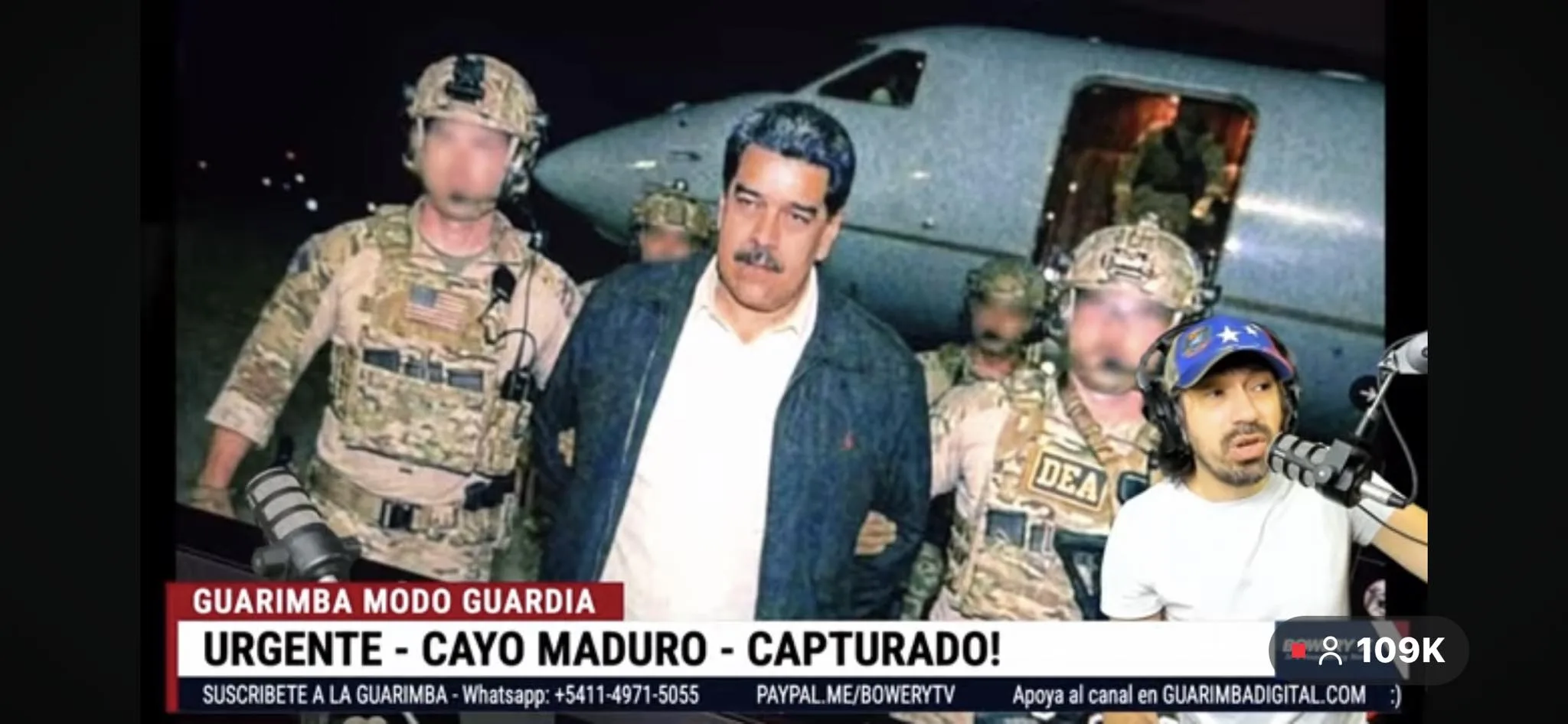
A pre-dawn operation shakes Caracas, and the world’s most oil-rich nation wakes up without the man who has ruled it for more than a decade.
3 Narratives News | January 3, 2026 (Freshly Update)
Editor’s note: This is a fast-moving story. Details, casualty counts, and legal filings may change as governments release new information.
Intro
My sister Marina in Caracas went to bed expecting an ordinary Saturday. Instead, she woke to a sound she couldn’t place at first – not thunder, not construction, not the usual city noise. Then came the low, heavy sweep of aircraft overhead. The kind of noise that makes the body sit upright before the mind catches up.
For hours, we messaged across the corridor of the Americas, Vancouver to Caracas, trying to decide what we were hearing. She described flashes and a trembling window line, and then the unnerving quiet between bursts; she could see American Fighter Jets outside her window. By morning, the United States had announced something almost unimaginable: President Donald Trump said U.S. forces had captured Venezuela’s President Nicolás Maduro and his wife, Cilia Flores, and flown them out of the country.
Context: What We Know, and Why It Matters
According to U.S. and international reporting, the operation unfolded before dawn on January 3, 2026, with strikes and explosions reported in and around Caracas. Trump publicly claimed Maduro and Flores were captured and moved to a U.S. warship, and that they would face U.S. justice in New York.
At a Mar-a-Lago news conference, Trump said: “We’re going to run the country until such time as we can do a safe, proper and judicious transition.”
The USA will run the government and invest billions in the oil industry in collaboration with the Vice President of Venezuela, Delcy Rodríguez.
Trump mentioned that he will stay in Venezuela for as long as it takes because he wants to help, and more importantly, the Venezuelan oil revenue will pay for everything it has cost them so far and will cost in the future.
Maria Corina Machado and the President-elect, Edmundo González, have not been included in the transition to a new government.
Venezuelan officials, meanwhile, denounced the strikes as an “imperialist attack,” alleging civilian and military sites were hit. Reporting also indicates casualties were claimed by Venezuelan authorities, though numbers remain unclear in the early hours.
Why it matters is simple and enormous. Venezuela sits on the world’s largest proven oil reserves, yet its production has collapsed over decades of mismanagement, underinvestment, and sanctions. A sudden leadership rupture, paired with Trump’s declaration that the U.S. will be “strongly involved” in Venezuela’s oil sector, turns an already fragile country into the most consequential geopolitical question in the hemisphere overnight.
Vice President sworn as President Delcy Rodriguez is defiant in the same room are all of the Maduro Senior team including Vladimir Padrino López who are demanding the release of Maduro. This story may not be over.

Narrative 1 (Side A): Washington’s Story — “A Precision Operation, a Law Enforcement Moment, and a Reset”
In the official U.S. telling, this was not war for war’s sake. It was the culmination of a campaign the administration has framed as a defense of Americans, a disruption of narcotics networks, and the removal of a leader already indicted by U.S. prosecutors on “narco-terrorism” allegations. The operation, as described in reporting, involved elite units, extensive rehearsals, and intelligence work tracking Maduro’s “pattern of life.”
Trump’s own language has been deliberately cinematic, emphasizing competence and inevitability. He described Maduro’s residence as a “fortress,” praised the “breathtaking” performance of U.S. forces, and argued the mission should warn anyone who threatens U.S. sovereignty.
What happens next, in this worldview, is “stabilization”: preventing a power vacuum, protecting infrastructure, and installing a transition framework that is “safe” and “judicious.” That is why Trump said the U.S. would “run the country” temporarily, to ensure the successor system doesn’t recreate the same regime under a new name.

Then comes the oil. Not as a slogan, but as a logistical reality. Venezuela’s crude output is currently a fraction of what it once was. Reuters summarizes the blunt arithmetic: Venezuela produced as much as 3.5 million barrels per day at its peak, but averaged around ~1.1 million barrels per day recently.
Even before today’s strike, exports were being squeezed. Reuters reported that a U.S. blockade in December halved exports from roughly 950,000 bpd in November, and that shipping firms were avoiding Venezuelan waters, leaving PDVSA juggling storage and flow.
In this narrative, a U.S.-led transition would remove the two biggest brakes on recovery: sanctions constraints and investor fear. Trump told Fox News the U.S. would be “very strongly involved” in Venezuela’s oil sector. Reuters also reported Trump saying China would “get the oil,” without elaborating a signal, perhaps, that existing buyers and debts will be handled pragmatically rather than torched.
Our estimate: What are the chances Venezuela runs its oil industry at “full capacity”?
First, define “full capacity.” Historically, “full” in public imagination means returning near the old peaks, roughly 3.0–3.5 million bpd. That’s not a switch you flip. Venezuela’s reserves are largely heavy crude in the Orinoco belt, which is “technically relatively simple” to produce but expensive, and highly dependent on functioning upgraders, diluent supply chains, power reliability, and skilled field services.
With that in mind, here are realistic probability bands, based on today’s baseline output (~1.1m bpd), documented constraints, and historical precedents cited by analysts (Libya and Iraq are often invoked as cautionary examples for post-intervention oil recovery).
- “Operational normal” (1.1–1.4 million bpd) within 6–12 months: 65–80%. The system is already producing around this range, and Reuters reported PDVSA facilities were largely unscathed by the strike, suggesting near-term continuity is plausible if security holds.
- “Meaningful rebound” (1.6–2.2 million bpd) within 2–4 years: 30–45%. This requires sanctions clarity, credible contracts, stable power and ports, and rapid re-engagement by service firms and joint-venture partners. The upside is real, but it depends on politics staying boring, which is rare right after a leader is removed.
- “Near-peak capacity” (3.0–3.5 million bpd) within 7–10 years: 10–20%. This is the moonshot scenario: sustained stability, billions in capex, environmental remediation, labor rebuilding, and a legal framework investors believe won’t be reversed by the next political turn. Analysts quoted by Reuters warn recoveries “take time,” and forced regime change rarely stabilizes supply quickly.
Bottom line, from Side A: the administration can plausibly deliver a short-term “steady” oil system, but “full capacity” is a long, expensive reconstruction project. In Washington’s preferred story, that’s exactly why the U.S. wants oversight: to keep the transition orderly enough that rigs, pipelines, ports, and refineries can work again without being ransomed by politics.
Suggested internal reads: This moment also echoes our earlier look at the philosophy behind force-first statecraft: “Peace Through Strength,” and the gamble that can backfire. And the U.S. framing of “national security” through public health shows up in our fentanyl coverage: The Fentanyl Paradox.
Narrative 2 (Side B): Caracas’s Story — “Kidnapping, Sovereignty, and a Resource Grab in Plain Sight”
From the Venezuelan state’s perspective, the central fact is not a courtroom indictment in New York. It is a foreign power striking the capital at night and removing the head of state. Call it capture, call it abduction, call it “kidnapping,” as a pro-government figure did in AP reporting. The semantics are not trivial; they are the argument.
In this narrative, the strikes are not “precision.” They are a violation of sovereignty with unpredictable consequences for civilians, power grids, and public order. Reports described explosions and outages in parts of Caracas. The point, in this worldview, is intimidation: shock the population, fracture the chain of command, then claim legitimacy afterward.
And then there is oil, the quiet drumbeat under every loud event. Venezuelan officials and sympathetic voices have long argued that “drug trafficking” rhetoric is a cover story for resource control. People.com, summarizing international coverage, quoted Maduro accusing the U.S. of trying to seize strategic resources, “particularly its oil and minerals,” and forcibly break political independence.
Trump’s own words, to them, are the proof: “We’re going to run the country.” In Caracas’s telling, that is occupation language, not transition language. And if the U.S. is “strongly involved” in the oil sector, then the next chapter is not reconstruction, it is extraction, with Venezuela treated as an asset rather than a nation.
Side B predicts the near-term future as a contest of legitimacy: protests, competing claims to authority, and an international scramble at the UN and regional bodies. The fear is not only regime change. It is fragmentation: armed factions, reprisals, and a country that becomes a chessboard because it has the misfortune of sitting on 303 billion barrels of proven reserves.
The People Between the Airstrikes and the Oil Ledgers

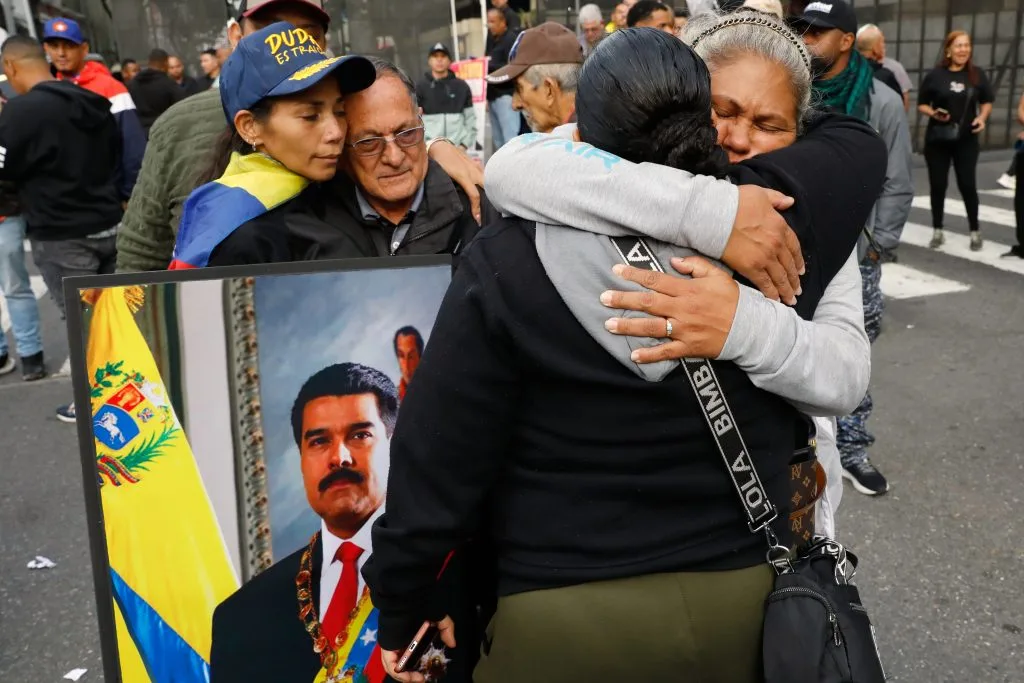
The silent story is what happens to people who never asked to be symbols.
In Caracas, families make the same calculations families make in every unstable moment: where are the documents, how much cash is left, who has medicine, who has a car with a full tank, which cousin lives closer to a safer neighborhood. In the oil regions, workers who have spent years keeping aging equipment alive with improvised parts now wonder who will be in charge of their paychecks tomorrow, and whether their facilities will become targets, trophies, or bargaining chips.
Even before this weekend, Venezuela’s oil system was under extreme operational strain. Reuters reported storage nearing capacity and exports “almost paralyzed” under pressure, forcing PDVSA into desperate logistics. Another Reuters report described how the blockade and shipping risk were already distorting flows, with PDVSA resorting to manual workarounds after a cyber disruption.
That’s what gets lost in the arguments about legality and liberation. Oil is not only geopolitics. It is diesel for generators, fuel for ambulances, and revenue that pays for imported food in a country that has watched its institutions thin out year by year. If the transition becomes chaotic, the first “casualties” may not be counted on a battlefield. They will show up in pharmacy shelves, in school closures, in the quiet decision to leave.
Key Takeaways
- On Jan. 3, 2026, the U.S. struck sites in/near Caracas and Trump announced the capture of Nicolás Maduro and Cilia Flores.
- Trump says the U.S. will “run” Venezuela temporarily during a transition.
- Venezuela’s oil output is about ~1.1 million bpd versus historical peaks near 3.5 million bpd.
- Exports were already disrupted by a U.S. blockade; flows and storage have been under heavy strain.
- Our estimate: “full capacity” (3.0–3.5m bpd) within 7–10 years is possible but unlikely without long-term stability and massive investment.
Questions This Article Answers (FAQs)
1) Did the U.S. really capture Nicolás Maduro, and where is he now?
Trump says Maduro and Cilia Flores were captured overnight and transferred via U.S. military assets toward New York for prosecution. International reporting confirms the U.S. claim of capture, while Venezuelan officials demand proof and denounce the action.
2) Is the U.S. actually “running” Venezuela right now?
This phrasing from President Trump appears to signal immediate security oversight rather than a permanent colonial administration. Practically, it likely implies U.S. military control over key assets (like airports and oil terminals) to prevent looting or sabotage while a transitional government is formed. However, critics argue this language confirms a loss of sovereignty and fears of a long-term occupation.
Subscriber Teaser
Does the promise of a “safe transition” justify the use of force, or does it set a dangerous precedent for sovereignty in the region? Tell us what you think in the comments.


