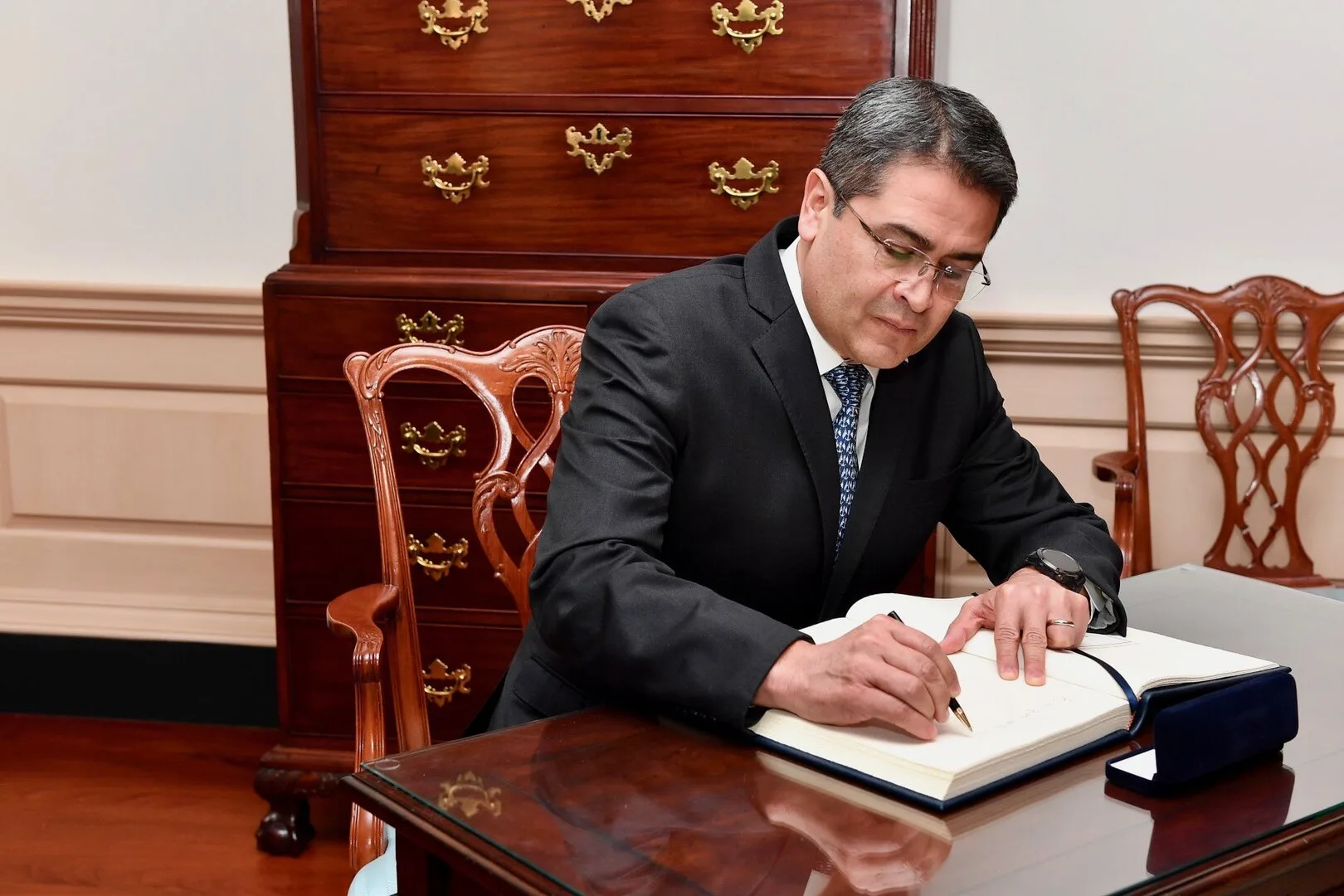
On a Tuesday morning in West Virginia, the prison gate at Hazelton opened, and a man who once led a country walked out. Juan Orlando Hernández — the former Honduran president convicted in New York of helping move hundreds of tons of cocaine to the United States — was suddenly free, thanks to a presidential pardon from Donald Trump. In Tegucigalpa, his wife posted a screenshot of the Bureau of Prisons website and thanked Trump “for returning him to being a free man.” In Washington, prosecutors and diplomats stared at their screens and wondered what, exactly, the word “ally” means now.
3 NARRATIVES NEWS — December 3, 2025
Context: From U.S. Ally to U.S. Inmate — and Back Out Again
For nearly a decade, Juan Orlando Hernández, known everywhere in Honduras by his initials, JOH, was held up in Washington as a partner in the U.S. “war on drugs” and migration. He ran Honduras from 2014 to 2022, survived a disputed re-election, kept close ties with both the Obama and Trump administrations, and sent Honduran troops into the streets in the name of security and order.
By 2019, U.S. prosecutors were telling a very different story. In court filings in New York, they alleged that Hernández and his allies had turned Honduras into a de facto narco-state, using the military, police, and political system to protect cocaine shipments and to channel drug money into campaigns.
In April 2022, days after leaving office, Hernández was extradited to the United States. In March 2024, a federal jury in the Southern District of New York found him guilty on three counts related to drug trafficking and weapons conspiracy. Prosecutors said he had helped create a “cocaine superhighway” that moved more than 400 tons of cocaine north; in June 2024, a judge sentenced him to 45 years in prison.
On December 2, 2025, that story twisted again. Trump’s pardon wiped away the sentence and let Hernández out of prison, even as the written judgment and mountains of trial evidence remained on the books. The move came in the middle of a knife-edge Honduran election in which Trump openly backed Hernández’s party ally Nasry “Tito” Asfura, and it followed weeks of lobbying by conservative operative Roger Stone and a flattering letter from Hernández that conservative outlet The Gateway Pundit published as “heartfelt.”
Trump, for his part, has framed the case against Hernández as a political hit job. In posts on his social platform and comments to reporters, he said the former president had been
“treated very harshly and unfairly”
and that “the people of Honduras” asked him to intervene.
To understand why this matters, it helps to know who Hernández was before the mugshot, how the U.S. built its case, and why Trump’s decision has set off such a furious argument about justice, alliances, and power.
Who Is Juan Orlando Hernández? From Law Professor to President
Hernández was born in 1968 in the mountain town of Gracias, the fifteenth of seventeen children in a coffee-growing family. He studied law and social sciences at the National Autonomous University of Honduras, taught constitutional law there, and earned a master’s degree in public administration with an emphasis on U.S. legislation.
He entered politics young, becoming a congressional aide to his brother and then, in 2001, a National Party deputy for the rural department of Lempira. Inside the National Congress, he rose quickly, pushing transparency measures and helping modernize the legislature’s communication tools. By 2010, he was president of Congress, with a reputation as a disciplined operator who understood both law and the machinery of party power.
In 2013, he ran for president on a hard-security platform, promising to send the military into the streets, crack down on gangs, and bring down one of the world’s highest homicide rates. He narrowly won. In 2017, after a controversial Supreme Court decision allowed re-election, he ran again and was declared the winner by half a percentage point in an election the Organization of American States criticized as lacking credibility. Protests left dozens dead and hundreds arrested, and the opposition accused him of entrenching an authoritarian model behind a law-and-order script.
Yet in Washington, the picture looked different. A White House readout from a 2017 meeting with Vice President Mike Pence praised Honduras’s “important progress” in fighting violent crime and corruption, and U.S. aid continued to flow under the U.S.-backed Alliance for Prosperity framework in Central America.
How the U.S. Case Was Built: Investigation, Extradition, Conviction
The U.S. investigation into Hernández did not start when he left office. As early as 2015, court filings in New York named him as a co-conspirator in a drug-trafficking and money-laundering case involving his brother, Juan Antonio “Tony” Hernández. Prosecutors alleged that $1.5 million in drug proceeds helped fund JOH’s successful 2013 presidential campaign.
In 2019, U.S. prosecutors publicly described Honduras under JOH as a place where politicians and traffickers “leveraged drug trafficking to maintain and enhance their political power.” Tony Hernández was eventually convicted and sentenced to life in prison. Behind the scenes, investigators were already piecing together a separate case against the president himself.
After JOH left office in January 2022, the shield of power vanished. The State Department revoked his visa, citing corruption and narcotics involvement. Days later, Honduran police surrounded his home in Tegucigalpa at the request of the U.S. government. The Honduran Supreme Court approved his extradition after a series of hearings; on April 21, 2022, Hernández was flown to New York under DEA escort.
In the Southern District of New York, he was charged with conspiring to import massive quantities of cocaine into the United States and with firearms offenses. The indictment alleged that since at least 2004, he had accepted millions of dollars in bribes from traffickers including money linked to Sinaloa cartel boss Joaquín “El Chapo” Guzmán, and used the Honduran military, police, and radar data to protect cocaine shipments.
Hernández pleaded not guilty and said he had been framed by the very traffickers he had fought. After a three-week trial in early 2024, a jury convicted him on all counts. In June, Judge P. Kevin Castel imposed a 45-year sentence, calling his conduct a betrayal of both Honduras and the United States.
Trump’s Pardon and His Own Explanation

Trump’s pardon upends that carefully built case without actually refuting it. The conviction remains; the punishment disappears.
Publicly, Trump has framed the decision in three ways:
- As mercy for an ally: He has emphasized Hernández’s past cooperation with U.S. policy and said that “many people that I greatly respect” told him the former president had been treated unfairly.
- As a blow against politicized justice: Trump has claimed, echoing language he uses about his own cases, that the prosecution was a “Biden administration set-up” that targeted Hernández because he was a conservative leader.
- As a response to Honduran opinion: When asked by reporters why he did it, Trump said, “I was asked by Honduras, many of the people of Honduras.”
Meanwhile, U.S. prosecutors and many in the diplomatic community see something very different: years of work undercut, signals to other leaders that Washington’s anti-drug promises are negotiable, and a new precedent in which a convicted foreign head of state can escape a long sentence if he has the right friends in the White House.
Narrative 1: The Trump Administration Story — A Loyal Partner Wronged
In this telling, we stay inside the Trump world’s own logic and language.
Here, Juan Orlando Hernández is not a villain but a partner who stood on the front line while others looked away. As president, he cooperated with U.S. authorities, extradited traffickers, and accepted the political cost of putting soldiers in the streets to fight gangs. He built ties with both Democratic and Republican administrations, worked on migration plans with Joe Biden when he was vice president, and later opened Honduras’s embassy in Jerusalem, aligning with Trump’s own Middle East moves.
From this vantage point, the New York case looks selective. Traffickers who once feared Hernández, the argument goes, cut deals with prosecutors and invented stories to save themselves. A “Deep State” Justice Department, the same one Trump rails against in his own criminal cases, supposedly seized on those tales to turn an ally into a symbol, all while ignoring corrupt left-leaning leaders elsewhere.
Conservative media that champion the pardon lean heavily on this view. The Gateway Pundit, which published Hernández’s prison-cell letter to Trump, highlights his family’s insistence that he suffered “tremendous injustice… at the hands of the Biden DOJ and Deep State.” In this narrative, the letter is not flattery; it is a plea from a besieged ally to the only man who will listen.
Trump’s own framing that
“the people of Honduras”
believe Hernández was set up, folds that story into a broader theme: that global elites and liberal prosecutors punish strong leaders who defend borders, fight socialism, and stand with the United States.
Within that worldview, the pardon is straightforward. A trusted partner in a dangerous region was taken down by politicized prosecutors and self-interested witnesses. The job of a president who sees the world in terms of loyalty and betrayal is to correct that injustice, especially when it was carried out, in Trump’s words, by people “who’ve been very unfair” to him as well.
Seen this way, the outrage from Democrats, human-rights groups, and career officials is part of the same pattern: the establishment cannot forgive a president who refuses to play by its rules, whether in Washington or Tegucigalpa.
Narrative 2: Alternative Media Theories — Why This Pardon, and Why Now?
In this narrative, we step into the world of critical and alternative outlets on both right and left, which offer their own theories about why Trump did this.
On the Right: The Letter, the Lobbyist, and the “Real Story”
On the pro-Trump, populist right, the focus falls on personal relationships, not policy. The story starts with Hernández’s handwritten letter from prison, carried into Trump’s orbit by Roger Stone and amplified by the conservative site The Gateway Pundit. In publishing the letter, a Gateway Pundit guest contributor described it as “a heartfelt letter addressed to President Trump, telling the story of the injustices perpetrated upon him.”
In this telling, what moves Trump is not geopolitics but a familiar narrative: a man claiming he was targeted by the same “corrupt system” that targeted Trump. By likening his own prosecution to Trump’s, praising Trump’s leadership, and framing his case as part of a broader persecution of conservatives in Latin America, Hernández positions himself as a victim of the global anti-Trump establishment. The pardon then becomes a kind of solidarity gesture between persecuted men, each insisting the other’s conviction proves the system is rigged.
On the Left: Hypocrisy, Oil, and the Price of Friendship
On the critical left and civil-liberties side, writers see something more structural. Techdirt, in a column by legal writer Tim Cushing, frames the pardon as the clearest example yet of the drug war’s double standard. Cushing notes that while Trump orders lethal strikes on suspected drug boats,
“he’s letting the drug dealers he personally likes off the hook.”
Other analysts connect the dots between Honduras, Venezuela, and U.S. foreign policy. At the Quincy Institute’s Responsible Statecraft, researcher Lee Schlenker points out that U.S. prosecutors described Hernández as effectively running Honduras “like a narco-state,” and argues that the pardon undercuts Trump’s own case for a wider drug war. In a cross-published piece at Common Dreams, journalist Atticus Canham-Clyne reminds readers that after the 2009 coup, Hernández, then head of Congress, was Washington’s man in Tegucigalpa, “seen as particularly amenable to Washington’s desires,” even as human-rights abuses and creeping authoritarianism mounted.
Some commentators go further, openly speculating about money or future deals. In the Techdirt comment section under Cushing’s article, a user posting as “Rocky” writes,
“I’m just wondering how much money Hernández ‘donated’ to get a pardon,”
while another commenter, “David”, argues that Trump’s simultaneous escalation against Venezuelan traffickers “is not about drugs” at all, but about Venezuela’s oil and regime change. These are comments, not reporting, and there is no public evidence to substantiate their suspicions. Still, they capture a widespread feeling on the left that law, business, and power in the region are tightly intertwined.
In this narrative, the pardon is not an anomaly. It is exactly what you would expect in a system where a leader can declare war on alleged narco-boats one day and free a convicted drug-war partner the next, so long as the alliances line up.
The Silent Story: Law, Alliances, and Who Gets to Be a “Good” Criminal
Underneath the partisan arguments about Hernández and Trump lies a quieter question: how does law actually work once it intersects with geopolitics and long-term alliances?
Latin American history is full of figures who were embraced as partners until the relationship changed. Panama’s Manuel Noriega worked with U.S. intelligence for years before being indicted and later convicted in the United States on drug-trafficking charges. In Mexico, Genaro García Luna, once the U.S.-backed public security minister, is now serving a U.S. sentence for taking bribes from the Sinaloa cartel. Hernández himself went from White House photo-ops to a New York jury box, then from an orange jumpsuit to a presidential pardon.
In each of these stories, the same person has been seen, at different moments, as both a “trusted ally” and a central figure in narcotics cases. Those shifts have less to do with any single headline and more to do with how different institutions, governments, courts, intelligence agencies, and voters view them over time.
For Hondurans, the stakes are not abstract. Many of the people who fled gangs and poverty in JOH’s Honduras now live in the United States under precarious status. They heard U.S. officials praise his security policies, then later heard U.S. prosecutors describe a political class awash in cartel money. Now they see the man those prosecutors called a key player in a cocaine pipeline walk free after a decision in Washington reverses his sentence.
For Americans, the case can raise its own questions. Suppose a foreign leader can be prosecuted as a trafficker in New York and later have his punishment cancelled after personal appeals and high-level advocacy. What does that suggest about the way justice is applied across different defendants and different kinds of cases?
And for the rest of the region, the Hernández saga becomes another reference point in a longer conversation. Some observers see it as evidence that law and order, especially in drug cases, always sit alongside other factors, the strategic partnerships, domestic politics, and the changing priorities of those in power.
When you strip away the rhetoric, that is the quieter story running beneath the headlines from Hazelton and Tegucigalpa. How much of what happened here is law, and how much is politics? Different readers, looking at the same facts, will answer that in different ways.
Key Takeaways
- Juan Orlando Hernández, a former U.S.-backed Honduran president, was convicted in New York for helping move hundreds of tons of cocaine into the United States and sentenced to 45 years in prison before being pardoned by Donald Trump.
- Hernández’s rise included real credentials — law degrees, a professorship, congressional leadership — and years of close cooperation with U.S. administrations that praised his security policies even as corruption and abuse allegations mounted at home.
- The U.S. case against him was built over years, tying him to cartel bribes, protection for cocaine shipments, and the use of Honduran state power to support a “narco-state” political machine.
- Trump’s public justification for the pardon leans on claims of unfair prosecution, personal appeals from Hernández and his family, and the idea that “the people of Honduras” wanted the former president freed.
- Alternative media on the right and left offer sharply different theories: from a persecuted ally rescued by a sympathetic president to a case study in drug-war hypocrisy and the price of political friendship.
- The deeper pattern — from Noriega to García Luna to Hernández — suggests that in drug politics, the line between “partner” and “criminal” often shifts with alliances, not just with evidence.
Questions This Article Answers
- Who is Juan Orlando Hernández, and why did the U.S. prosecute him? Hernández is a Honduran lawyer and politician who served as president from 2014 to 2022. U.S. prosecutors accused him of taking cartel bribes and using Honduran state power to protect cocaine shipments to the United States; a New York jury convicted him in 2024 on drug-trafficking and firearms-conspiracy charges.
- How did the investigation, extradition, and conviction unfold? Hernández appeared in U.S. court documents as early as 2015, was formally investigated while still in office, had his visa revoked in 2021, and was arrested and extradited from Honduras in 2022. His trial began in February 2024 and ended with a guilty verdict and a 45-year sentence in June 2024.
- What reasons has Donald Trump given for pardoning Hernández? Trump has said Hernández was “treated very harshly and unfairly,” claimed the case was a politically motivated “Biden set-up,” and insisted that many Hondurans asked him to intervene on Hernández’s behalf.
- How do alternative media on the right and left interpret the pardon? Pro-Trump outlets such as The Gateway Pundit present Hernández as a wronged ally who appealed personally to Trump through a “heartfelt” letter, while sites like Techdirt and other left-leaning analysts argue the pardon exposes drug-war hypocrisy and raises questions about money, influence, and U.S. strategy in Latin America.
- What does this case reveal about law, alliances, and drug-war politics? The Hernández saga shows how the same leader can be embraced as a security partner and condemned as a trafficker, depending on political needs — reinforcing a long-running pattern in which justice in the drug war often tracks alliances more than it does consistent principles.
For more on how 3 Narratives News handles complex geopolitical stories, see our explainer “Trump, China and Venezuela: Four Reasons This Standoff Matters.” For a look at how we use AI research assistance in the newsroom, read “Truth and Lies About AI Assistance in the Newsroom — Revealed.”


