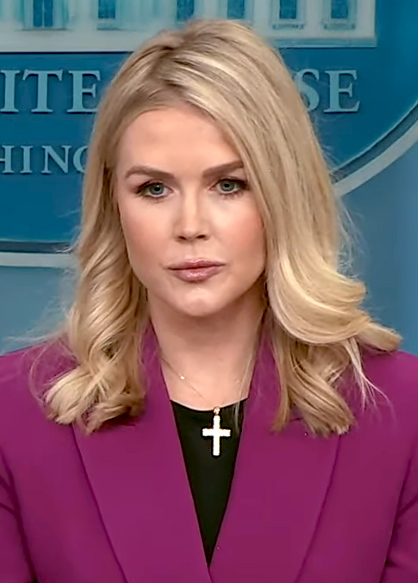
How the youngest White House Press Secretary became the standout of Trump’s second-term reboot — and why critics say her discipline hides a harder edge.
By 3 Narratives News |
In just 100 days, President Trump’s second term has introduced a new cast of power players. Few have risen faster than Karoline Leavitt, the 27-year-old White House Press Secretary from Atkinson, New Hampshire.
A former softball player, pageant contestant, and communications aide, Leavitt is now the most polished and disciplined public face of Trump 2.0. In a West Wing full of strong personalities, she has done what none of her predecessors managed in Trump’s first term: deliver his message clearly, confidently, and without becoming the daily scandal herself.
Her briefings are crisp and assertive. She leans hard into Trump’s themes—border control, economic revival, “America First,” and cultural battle lines—while avoiding the improvisational chaos that once defined the press room.
Narrative 1: The Disciplined Star of Trump’s Comeback
To Trump supporters, Karoline Leavitt is exactly what the second term needed: young, sharp, unflappable, and fiercely loyal.
Her backers argue that she has brought order and focus to a job that used to be a revolving door. In Trump’s first administration:
- Sean Spicer became a punchline over crowd-size claims.
- Sarah Huckabee Sanders was admired on the right but criticized as combative and evasive by much of the press.
- Stephanie Grisham never held a single formal press briefing.
- Kayleigh McEnany fought fiercely with reporters, often intensifying the drama rather than calming it.
Leavitt, by contrast, walks into the briefing room knowing she is on camera not just for Washington, but for Trump’s base watching on cable and social media. Supporters say she has “held the room” without lighting it on fire.
Her style is deliberate. She opens with a tight message on the administration’s priorities—whether that is the border, tariffs, or what Trump calls “rebuilding American strength”—and repeats those themes throughout the briefing. When challenged, she often pivots back to the script instead of trading insults, letting Trump himself handle the raw attack lines later at rallies or on social media.
In this reading, Leavitt is the professionalizer of Trump’s second-term message: someone who learned from the chaos of 2017–2020 and is now intent on making “Trumpism” look more organized and less impulsive, without changing its core themes.
Narrative 2: The New Gatekeeper with Old Tactics
To her critics, however, Leavitt’s discipline is not reassuring—it is worrying. They see a press secretary who blends tight message control with selective access, misinformation, and a willingness to attack the media itself.
Selective Media Access and Accusations of Bias
From her first briefings, Leavitt signaled that she would shake up who gets to ask questions. She has elevated non-traditional or openly partisan outlets, given friendly platforms more time, and clashed with legacy organizations like the New York Times and the BBC.
In one widely reported exchange, after a Times reporter compared Trump’s media tactics to Vladimir Putin’s treatment of the press, Leavitt fired back on social media, declaring that the days when “left-wing stenographers posing as journalists” dictated the terms of access were over. Supporters cheered; press freedom advocates saw it as another step in turning the briefing room into a loyalty test.
For critics, this is not just a cosmetic change in tone. They argue that who gets to ask questions is itself a form of power: if the White House sidelines skeptical outlets and promotes only those who echo its talking points, the public hears a narrower, more curated version of reality.
The Gaza Condoms Claim and Misinformation
Leavitt also drew sharp scrutiny when she claimed at a briefing that about $50 million in U.S. taxpayer money was about to be spent on condoms in Gaza—using it as a justification for a sweeping freeze on foreign aid and health spending. Subsequent reporting and independent analyses found no evidence of such a program, and fact-checkers concluded the claim was false.
To her opponents, this episode encapsulated the danger of her discipline: the briefing room may look calmer, but if the facts at the podium are wrong, the damage is still real. They see a press secretary who speaks in polished paragraphs while spreading misinformation that can shape public opinion and policy debates far beyond Washington.
Confrontations with Journalists and the Tariff Debate
Leavitt’s exchanges with reporters have, at times, turned combative. In one notable clash over Trump’s tariff policies, she argued that tariffs functioned as a “tax cut for the American people.” Critics, including MSNBC anchor Nicolle Wallace, called the claim either “tragically uninformed or lying,” noting that most economists see tariffs as taxes paid by consumers and businesses, not foreign governments.
For viewers who already follow our coverage of the administration’s trade battles—especially the looming U.S.–Canada tariff war and Trump’s economic promises—Leavitt’s answers are part of a larger pattern: using the briefing podium to defend policies that many experts say shift costs onto ordinary people.
These confrontations have fueled a debate not just about Leavitt’s style, but about the purpose of the modern press secretary. Is the job to inform the public, or to spin the public on behalf of a president locked in constant conflict with the press?


The Silent Story: What Her Rise Says About Trump’s War with Institutions
Beneath the daily clips and cable segments, Karoline Leavitt’s rise points to a quieter but deeper story: how a president and a movement, entering a second term, are reshaping the relationship between the White House and democratic institutions.
For Trump, the press has long been both antagonist and amplifier. He needs the conflict—the “fake news” rallies, the viral clips, the back-and-forth with individual journalists—as much as he claims to despise it. A press secretary like Leavitt helps him manage that conflict, turning it into something more controlled, more curated, and arguably more effective.
Her job is not only to answer questions, but to signal a worldview: that traditional news organizations are untrustworthy, that conservative media and social platforms are the true voice of the people, and that any pushback on facts—from Gaza funding to tariff economics—is just more evidence of elite bias.
In that sense, the Silent Story here is not simply about one spokesperson. It is about:
- A new information ecosystem where presidents can bypass skeptical outlets and speak directly to supporters.
- A press corps under pressure to decide whether to keep showing up to a room where access may depend on political alignment.
- A public caught in the middle, trying to decide which narrative is credible when every side accuses the other of lying.
Leavitt’s supporters would say this is overdue correction: the establishment media finally being forced to share space with outlets that represent Trump’s base. Her critics would answer that this is how democratic norms erode—not with a dramatic shutdown of the press, but with a slow narrowing of who gets called on and which questions get answered.
As we’ve explored in other pieces—whether it’s MAGA versus “Trumpism” inside the movement or the administration’s approach to foreign crises—media strategy is no longer a side show. It is central to how power is exercised in Trump’s second term.
3 Narratives Breakdown
Narrative 1: The Disciplined Star of Trump’s Comeback
Karoline Leavitt is Trump’s most effective press secretary to date. Clear, loyal, and disciplined, she has redefined the role by avoiding personal scandal while speaking directly and confidently to the base. For supporters, she proves that Trump’s message can be sharp without being chaotic.
Narrative 2: The New Gatekeeper with Old Tactics
Behind the polish, critics see a press secretary who limits access, elevates friendly outlets, and repeats claims that independent reporting has debunked. In this view, Leavitt hasn’t tamed Trump’s war on the media—she has simply made it look more professional.
The Silent Story: You Decide Where the Line Is
Is Karoline Leavitt an antidote to the chaos of Trump’s first-term media strategy, or a smoother, younger face on the same aggressive tactics toward the press and facts themselves? The answer depends on where you believe the line should be drawn between message discipline and manipulation.
At 3 Narratives News, our role is to lay out these competing views—and the deeper system underneath them—so you can decide.









Thank you for your sharing. I am worried that I lack creative ideas. It is your article that makes me full of hope. Thank you. But, I have a question, can you help me?
Thanks for sharing. I read many of your blog posts, cool, your blog is very good.
Your article helped me a lot, is there any more related content? Thanks! https://accounts.binance.com/id/register?ref=FIHEGIZ8
Thank you, your article surprised me, there is such an excellent point of view. Thank you for sharing, I learned a lot.
Thank you for your sharing. I am worried that I lack creative ideas. It is your article that makes me full of hope. Thank you. But, I have a question, can you help me?
Thank you for your sharing. I am worried that I lack creative ideas. It is your article that makes me full of hope. Thank you. But, I have a question, can you help me?
Thanks for sharing. I read many of your blog posts, cool, your blog is very good.