
He came under Operation Allies Welcome. They came from small towns in West Virginia. On the day before Thanksgiving, their lives crossed on a D.C. sidewalk in a way none of them imagined.
By Carlos Taylhardat |
Editor’s note (updated December 2, 2025): This article has been updated to reflect the loss of Spc. Sarah Beckstrom from her injuries.
On the day before Thanksgiving, while most of Washington worried about flights, pies, and the first winter storm, Spc. Sarah Beckstrom, 20, and Staff Sgt. Andrew Wolfe, 24, buttoned their uniforms and stepped into a different kind of holiday duty.
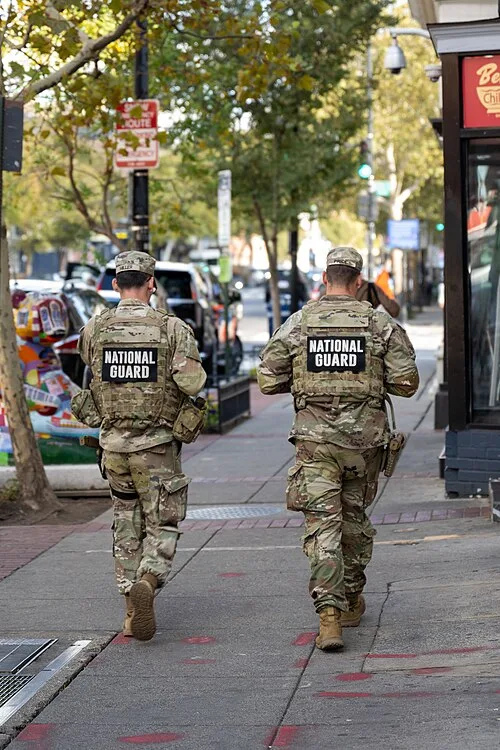
Their assignment was simple and visible: presence patrol. Walk the blocks around Farragut Square and the White House complex, answer tourists’ questions, be a reassuring splash of camouflage amid office workers and food trucks. It was their first day as deputized Guard officers in the capital, a formal step up after months of routine support work.
Beckstrom had volunteered to stay on through Thanksgiving so others with children could go home to West Virginia. Wolfe, an Air Guard noncommissioned officer from a few towns over, had signed up for the D.C. deployment back in August, part of President Donald Trump’s expanded National Guard presence in cities he said were overwhelmed by crime.
A little after 2:15 p.m. on November 26, at the corner of 17th and I Streets NW, just above the Farragut West Metro entrance, a man in a dark sedan watched them from the curb. Prosecutors say he had driven nearly the entire width of the United States to find a patrol like this one.
His name is Rahmanullah Lakanwal, a 29-year-old Afghan who once worked alongside U.S. forces in Kandahar and arrived in America under Operation Allies Welcome, the Biden-era program to evacuate at-risk Afghans after the Taliban takeover. Four years later, he was living with his wife and five children in Bellingham, Washington, holding a steady warehouse job, and trying, in outward ways, to be another suburban father in the Pacific Northwest.
According to charging documents, he stepped out of the car with a .357 Smith & Wesson revolver, walked toward the patrol, and opened fire.
What Happened Near the White House
Authorities say the attack was deliberate and methodical. U.S. Attorney Jeanine Pirro described it as a “brazen and targeted” ambush: the gunman first shot one Guardsman, kept firing as that soldier fell, then turned the weapon on the second. Other Guard members nearby returned fire, wounding the suspect and ending the shooting within seconds.
Viewer discretion: The following news clip shows raw footage from immediately after the shooting, including injured soldiers and chaotic scenes. Some viewers may find it disturbing. The clip was recorded in the minutes after the November 26, 2025, shooting near Farragut Square.
Witnesses heard a quick succession of cracks that echoed between glass office towers and the park’s trees, followed by screams and the metallic screech of car horns as traffic froze around Farragut Square. Office workers dropped to the sidewalk. Someone shouted that it was “another active shooter,” the phrase that has become a kind of American siren.
By the time Metropolitan Police officers and Secret Service units sprinted in from the White House perimeter, three people lay on the pavement: Beckstrom and Wolfe, bleeding heavily, and Lakanwal, wounded and disarmed, under the rifles of other guardsmen.
Both soldiers were rushed to MedStar Washington Hospital Center. Beckstrom, a rural West Virginian from Webster County, had been shot in the chest and head. Wolfe, from the Inwood–Martinsburg area, suffered multiple wounds to his torso. Surgeons operated for hours. As of Thursday morning, doctors described both as in critical condition, their families keeping vigil in separate waiting rooms. By Friday, military officials announced that Beckstrom had died of her wounds; Wolfe remained in critical condition.
At a news conference, Pirro stood at a podium flanked by the soldiers’ portraits on easels. Beside her was Kash Patel, the FBI Director, as agents circulated photos of a bearded man whose journey from Afghan battlefields to a Bellingham cul-de-sac to this D.C. street has become the newest flashpoint in America’s argument over refugees, war, and security.
The full news conference above took place on the morning of November 27, 2025, beginning around 9:15 a.m. Eastern, one day after the shooting near Farragut Square.
Behind the legal language of “assault with intent to kill while armed” and “use of a firearm during a crime of violence,” one fact stood out: the FBI is treating the shooting as an act of terrorism. The Trump administration has immediately ordered 500 more Guard troops to Washington and suspended Afghan immigration processing nationwide pending a review of everyone admitted under Operation Allies Welcome.
At 3 Narratives News, we believe you can’t understand a moment like this without understanding the people inside it. To make sense of this unfortunate and tragic encounter on a D.C. sidewalk, we have to follow Rahmanullah Lakanwal back to the life he led before the gunshots, and the two conflicting stories this country is now learning about him.
From Kandahar to Bellingham: Who Is Rahmanullah Lakanwal?
Narrative One: The Vetting Failure Story
In this version of events, Rahmanullah Lakanwal is not a tragic figure or a complicated product of a long war. He is a case study in a broken system.
Critics of Operation Allies Welcome—and of President Biden’s 2021 evacuation more broadly—have spent years warning that the program was rushed, sloppy, and politically motivated. They point to inspector-general reports showing that the Department of Homeland Security and its partners “lacked critical data to properly screen, vet, and inspect” evacuees in the chaotic weeks after Kabul’s fall, and that some Afghans were allowed to travel or enter the United States before all derogatory information had been checked and adjudicated.
Those warnings were already politically potent. Now they have a face.
Within hours of the shooting, President Donald Trump went on camera in the White House briefing room to call the attack “an act of terror carried out by a man this country never should have admitted.” He pledged a sweeping review of every Afghan admitted under Operation Allies Welcome and ordered an immediate, nationwide halt to new Afghan immigration processing. Senior Republicans in Congress revived demands for hearings on “Biden’s Afghan pipeline” and circulated earlier reports showing that dozens of evacuees had, at one point or another, appeared in watch-list databases.
After news of Beckstrom’s death, Trump returned to the cameras and called it “a grave loss for our country and for a family that gave us their daughter in uniform.” He added that “no American soldier should be gunned down on the streets of her own capital by someone we chose to let in.”
In this narrative, the biography that once made Lakanwal eligible for evacuation—service with CIA-linked units, side-by-side work with U.S. troops—reads differently. It becomes potential camouflage, the perfect résumé for a bad actor who knows how the system thinks and where its blind spots are.
The Silent Story: Three Futures Colliding on One Sidewalk
Strip away the political talking points, and what remains from that November afternoon are three young lives, two in uniform, one in handcuffs and hospital restraints, whose paths were shaped by decisions far above their heads.
Sarah Beckstrom grew up in Webster County, West Virginia, in the hills east of Charleston. Friends describe a quiet, stubborn teenager who gravitated to the National Guard at 18, in part for the structure and in part for the chance to see a world beyond her county line. Her commanders say she volunteered to stay on duty in Washington over Thanksgiving so soldiers with kids could be with their families.
Andrew Wolfe joined the Air National Guard in 2019. He came from the panhandle, from the I-81 corridor of chain restaurants, youth sports fields, and commuter traffic that ties West Virginia to the D.C. metro area. At the 167th Airlift Wing, he worked in force support, managing people, paperwork, and training pipelines. Friends talk about cornhole tournaments, late-night drives, and a pride in uniform that was earnest rather than performative.
Neither Beckstrom nor Wolfe planned to be in a firefight two blocks from the White House. Their mission, as explained to them, was to provide visible support to a capital where the President said crime and disorder were out of control. They expected bored shifts, not emergency surgery.
Rahmanullah Lakanwal spent his twenties in very different uniformed worlds: the fatigues of Afghan army and intelligence units, the soft-skinned SUVs of CIA-linked strike forces, the branded vests of humanitarian organizations. He has lived through the full arc of America’s longest war, from its optimistic middle years to the brutal night raids and drone strikes to the panicked evacuation and its hurried efforts to keep promises.
In Bellingham, neighbors saw a man trying to start over. His children walked to the local schools. He worked long shifts in warehouses, grabbed coffee in the same strip-mall plazas as everyone else, and occasionally appeared at community events organized for newly arrived Afghans. Underneath, according to people who knew him, he carried the weight of relatives still in danger and the knowledge that the war that defined him had ended with an uneasy exile.
On November 26, those three futures—a young woman from rural West Virginia, a small-town airman, and an Afghan evacuee—met on a corner of 17th Street. Two ended the day in operating rooms. One ended it under guard, facing the possibility of a life sentence or worse. In the days that followed, Beckstrom would die in the hospital from her wounds, while Wolfe remained in a long, uncertain fight to recover.
The silent story here is not only about a refugee who might, or might not, have been properly vetted. It is about how American policy turned all three into characters in the same unfinished narrative of war and security.
Key Takeaways
- The D.C. shooting is the collision of three biographies—an Afghan ally, a young Army specialist who has now died of her wounds, and a young Air Guard sergeant still fighting for his life—all shaped in different ways by America’s long war and its domestic politics.
- Operation Allies Welcome was designed to honor a promise to Afghans who worked with U.S. forces, but early watchdog reports flagged gaps in data and vetting that critics now point to as the root of this case.
- Republican leaders and the Trump administration frame the attack as proof of a vetting failure, using it to justify a halt to Afghan immigration processing and a wider immigration crackdown, and now invoking Beckstrom’s death as a symbol of that failure.
- Advocates for Afghan evacuees and some U.S. veterans see the suspect as one of many abandoned allies—men and women asked to fight in America’s wars and then left to navigate trauma and bureaucracy largely alone.
- The FBI is investigating the shooting as terrorism, but the suspect’s exact motive remains unknown, leaving open questions about ideology, mental health, and personal grievance.
- The silent story is about systems, not only individuals: how policy decisions about war, resettlement, policing, and fear bring people who never should have met into each other’s line of fire.
Questions This Article Answers
Who are the two National Guard members shot near the White House?
The victims are Spc. Sarah Beckstrom, 20, of the 863rd Military Police Company, West Virginia Army National Guard, and Staff Sgt. Andrew Wolfe, 24, of the 167th Airlift Wing, West Virginia Air National Guard. Both were on their first day of formal deputized patrol duty in Washington, D.C., when they were ambushed near Farragut Square. Beckstrom later died of her wounds at MedStar Washington Hospital Center; Wolfe remains in critical condition.
Who is Rahmanullah Lakanwal and how did he come to the United States?
Rahmanullah Lakanwal is a 29-year-old Afghan national who previously worked with U.S.-backed forces and CIA-linked units in Afghanistan. He arrived in the United States in 2021 under Operation Allies Welcome, the Biden administration’s program for at-risk Afghans, and later settled in Bellingham, Washington, with his wife and five children. In April 2025, he was granted asylum after additional vetting, giving him legal status and work authorization.
What exactly happened during the shooting in Washington, D.C.?
According to investigators and court filings, Lakanwal drove from Washington state to Washington, D.C., and on November 26 approached a National Guard patrol near 17th and I Streets NW. Armed with a .357 revolver, he allegedly shot Beckstrom and Wolfe multiple times in an ambush-style attack before other Guardsmen returned fire and wounded him. The FBI is treating the incident as an act of terrorism. Beckstrom later died from her injuries; Wolfe remains hospitalised in critical condition.
What is Operation Allies Welcome and why is it being debated now?
Operation Allies Welcome is a U.S. government initiative launched in 2021 to resettle vulnerable Afghans—particularly those who worked alongside U.S. forces, diplomats, and humanitarian efforts—after the Taliban returned to power. Supporters see it as a moral obligation to former allies. Critics, citing inspector-general reports and congressional oversight, argue that the program’s rushed roll-out left gaps in screening and vetting. The suspected involvement of an OAW evacuee in the D.C. attack, and now the death of a young American soldier, has intensified this debate and prompted a temporary suspension of Afghan immigration processing.
How are politicians and officials responding to the shooting?
President Trump has denounced the shooting as an act of terror and ordered additional National Guard deployments to the capital, while calling for a comprehensive review of all Afghans admitted under Operation Allies Welcome. After Beckstrom’s death, he described it as “a grave loss for our country” and said that no American soldier should be gunned down on the streets of the nation’s capital by someone the United States chose to admit. Republican lawmakers are using the case to renew scrutiny of the Biden administration’s evacuation and vetting decisions. At the same time, human-rights groups and Afghan-evacuee advocates warn against collective punishment, arguing that suspending Afghan immigration over one case puts thousands of at-risk families in greater danger.
What deeper questions does this case raise beyond vetting and terrorism?
Beyond immediate security concerns, the case raises longer-term questions about how the United States treats those who fought alongside its forces, how it supports them once they arrive on American soil, and how domestic deployments of the National Guard intersect with the legacies of foreign wars. It invites readers to consider not just whether one man should have been admitted, but how three young people, each shaped by the same conflict in different ways, came to meet in the line of fire on a quiet city street—and why one of them will now never go home.
For more on how technology and media shape stories like this one, see our analysis “AI in the Newsroom: Truth, Lies, and What Readers Should Know.”