Home Investigative Report USMCA, CUSMA, T-MEC, or NAFTA: Whatever You Call It, Is It Dead?

USMCA, CUSMA, T-MEC, or NAFTA: Whatever You Call It, Is It Dead?

USMCA, CUSMA, T-MEC, or NAFTA: Whatever You Call It, Is It Dead?
#image_title

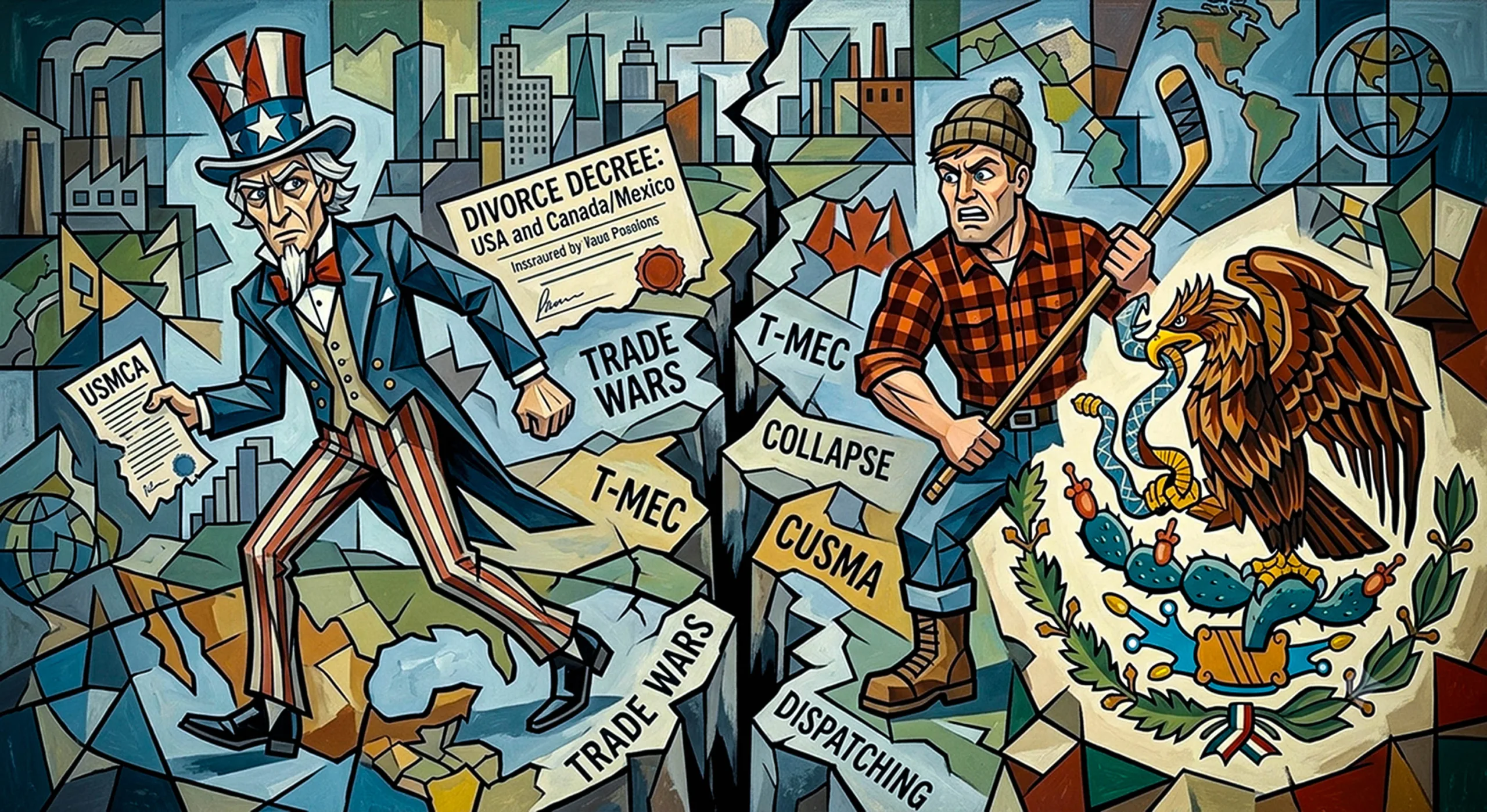
What will North America actually look like without a free trade agreement holding it together? Are the United States, Canada, and Mexico fundamentally stronger for having tied their supply chains together, or does that same integration make all three more fragile the moment one partner decides to pull back? I did not expect to find the clearest answer in a cheese shop in Cheshire, England, but that is where this story eventually led me.

Editor's Note: On July 1, 2026, the United States declined to renew the USMCA in its current form, triggering a decade-long cycle of annual reviews with Canada and Mexico rather than an outright collapse. This piece follows that decision, and the 50 percent tariffs that followed it, toward an answer the United Kingdom already has ten years of ground-level data on, told through the small businesses who lived it.

I did not start out trying to write about Brexit. I started out trying to answer a much narrower question, what does “joint review” actually mean when a trade deal’s mandatory checkup arrives? In trade negotiations, that phrase rarely means what the ink on the page suggests it means. So when the July 1 deadline came and went and Washington chose not to renew, my first instinct was not to ask whether the USMCA was dead. It clearly was not. What I actually wanted to know was what a decade of the alternative, annual uncertainty instead of a clean renewal, costs a continent. That question is what led me to the UK, because it turns out someone already ran this experiment, and the bill came due faster, and landed on different people, than almost anyone predicted back in 2016.

So What Actually Happened on July 1?

The first thing I had to untangle was what “declined to renew” means in practice, because it is easy to read that headline and assume the deal collapsed. It did not.

The U.S. Trade Representative’s office confirmed the decision the same day the trigger date passed. The agreement Americans call the USMCA, Canadians call CUSMA, and Mexicans call T-MEC, three names for one treaty. It is the successor to NAFTA, the North America Free Trade Agreement, a name the Trump administration insisted on retiring when this deal was first negotiated in 2020. The treaty has a built-in shock absorber for exactly this scenario. Refusal to renew shifts the pact into a cycle of annual joint reviews, not termination, that can run all the way until 2036, when the original deal was set to expire regardless. Nobody pulled the plug. They agreed to keep checking the pulse every year instead of committing to the next decade in one sitting.

That distinction matters more than it sounds like it should. A one-time renewal forces certainty. An annual review cycle institutionalizes unpredictability, on purpose, indefinitely.

The 2026 Pressure Cooker

What I was not expecting, while researching this, was how fast the temperature would rise.

The Trump administration invoked Section 338 of the Tariff Act of 1930, a provision that had not actually been used to impose a tariff since the Great Depression, to place 50 percent duties on roughly $20 billion of Canadian goods. Taking effect in mid-August, the duties cover motor vehicles, dairy, alcohol, and raw materials, a reminder of how quickly a routine diplomatic review can escalate into immediate economic pressure.

Canadian Prime Minister Mark Carney condemned the unilateral duties as a direct violation of the treaty framework, signaling that “everything’s on the table” if a fair path forward isn’t maintained. Mexican President Claudia Sheinbaum has taken a more measured posture, prioritizing quiet bilateral dialogue while navigating maximum-pressure tactics from Washington.

What If the Deal Ultimately Fails? A North America Divided

If these annual reviews repeatedly stall and the deal eventually lapses, North America reverts to World Trade Organization Most-Favored-Nation tariff schedules.

Cross-border supply chains, the kind where automotive components routinely cross borders three to four times before final assembly, would take the immediate hit. Economic modeling estimates that a full breakdown of regional free trade could slash long-run trade flows by 6.7 to 15.6 percent. Mexico would absorb the steepest consumption drop, followed by Canada and the United States.

Lessons from Brexit: The Cost of Disintegration

When a trade agreement collapses, or when new, retaliatory barriers like tariffs are erected, the most visible cost is the tax itself. But the hidden, much higher cost is what economists call trade friction, the non-tariff barriers of new customs declarations, mandatory product testing, and health certificates.

For a massive, multinational corporation, managing this friction is merely a logistical puzzle. They employ dedicated legal teams and possess the financial reserves to restructure supply chains. But for a small manufacturer, artisan, or farmer, that same paperwork can eviscerate profit margins, making cross-border trade functionally impossible. As one exasperated customer of a British wine merchant put it after watching the industry buckle, “legislation is always made by governments for blue-chip companies first.”

1. Small Businesses Pay First

The United Kingdom’s exit from the European Union provides a stark, quantifiable case study of this dynamic. Retrospectives on the decade since the referendum show that between 16,000 and 20,000 British businesses simply stopped exporting to the EU altogether. That decline was “entirely accounted for by small exporters with fewer than 10 employees,” while larger companies found ways to absorb the shock.

2. The Reality on the Ground

Consider the case of Simon Spurrell, co-founder of the Cheshire Cheese Company. Before Brexit, his company had built a thriving direct-to-consumer business across the European continent. After the UK left the single market, every retail order sent to the EU, even a personal gift pack of cheese worth just £25, required an official health certificate signed by a veterinary surgeon. The cost of that single certificate was £180.

Spurrell lost 20 percent of his total sales in the aftermath, describing the arrangement as, in his own words:

“The biggest disaster that any government has ever negotiated.”

A similar story played out for Daniel Lambert, who ran a wine import and export business in Wales. Before Brexit, moving a pallet of wine from France to Wales involved three key steps and cost around £165. Afterward, the process expanded into twenty administrative steps requiring separate excise duty paperwork on both sides of the Channel. Lambert’s annual cost of doing business climbed from £30,000 to £166,000, and he ultimately relocated the business to France to survive.

Mark Ormiston, a sixth-generation supplier whose small firm saw exports drop by a third, put the human reality in even blunter terms, describing small businesses as having simply been “flushed down the toilet.”

3. Uncertainty Acts as a Drag

What made Brexit expensive was not only the final terms, it was the years of uncertainty beforehand. The inability to forecast rules eighteen months out chilled business investment and hiring long before the official departure. North America has now stepped into that same zone of structural ambiguity.

The Brexit Lesson: Bureaucracy Is a Tax on Time and Money

Ten years of Brexit data show that ending a free trade agreement is not just about paying new tariffs, it is about the compounding cost of new paperwork and border checks.

  • Following the UK’s departure from the European Union, new trade regulations were introduced, including complex customs procedures and “Rules of Origin” requirements.
  • These new bureaucratic hurdles created significant friction in the movement of goods, with roughly 70 percent of UK companies reporting higher supply chain costs tied directly to the new regulations.
  • Customs procedures alone extended average delivery timelines by around 30 percent.
  • This burden disproportionately affected smaller businesses, which typically lacked the staff, capacity, or legal resources to navigate the new trade regulations.

The North American Reality: What Would Break Down?

If the USMCA is compromised and similar bureaucratic friction is introduced between the U.S., Canada, and Mexico, the primary casualty would be the region’s deeply interconnected manufacturing supply chain.

North American trade is currently highly efficient, but it relies entirely on seamless borders.

  • The Ping-Pong Supply Chain: Modern automotive production across North America is so deeply interconnected that components routinely cross borders multiple times before a vehicle reaches final assembly.
  • The Journey of a Single Part: Under the current system, a single component can be stamped in Mexico, transported to the United States to be machined, then shipped to Canada or back to Mexico to be assembled into a finished vehicle.
  • Reliance on Intermediate Goods: Roughly 70 percent of the trade growth between USMCA partners from 2020 through 2024 came in the form of capital or intermediate goods, parts used to build other things, rather than finished consumer products.
  • The Benefits of Integration: This seamless cross-border integration has lowered costs for consumers and supported millions of jobs in the United States alone.

The Collision of the Two Realities

Apply the UK’s 30 percent delivery delays and its new paperwork costs to the North American auto industry, and the system starts to buckle in the same places.

If a car part needs to cross the border three times during its manufacturing lifecycle, and each crossing suddenly requires new origin certifications, health and safety checks, and tariff evaluations, a production process that used to take days would take weeks. The massive automakers might be able to afford the legal teams to figure it out. The small, independent parts suppliers in Ontario or Michoacán would simply be priced out of the market, the same way Simon Spurrell and Daniel Lambert were.

Because of this level of integration, even relatively small changes to tariffs or rules of origin would carry significant commercial and operational consequences for the entire continent.

What would a similar divorce to UK and Europe look like for North America?

Sitting with the U.S., Canadian, and Mexican positions side by side, what strikes me is that none of the three governments is acting irrationally from where it stands. Washington believes the current rules of origin let too much foreign content ride into the U.S. market disguised as North American manufacturing. Ottawa believes it has already honored its 2020 commitments and is being punished anyway. Mexico City is calculating that measured diplomacy protects its long-term industrial position better than retaliation would.

But the systemic story underneath all three positions is the one Brexit already told, just in a different accent. Deeply integrated economies do not uncouple cleanly, and the price of that uncoupling is rarely paid by the negotiators who choose it. It is paid by the parts supplier in Ontario, the produce grower in Michoacán, the factory floor in Michigan, the version of Simon Spurrell or Daniel Lambert who has not been written about yet because the tariffs only took effect weeks ago. Governments negotiate over rules. Everyone smaller than a government has already built a business around them.

The Takeaway

Untangling a deeply integrated regional economy is not free, and it rarely stays contained to the companies large enough to survive it. Brexit’s ten year record shows the damage compounding well past the point most forecasters expected it to level off, and it shows exactly who absorbs it first. North America has not chosen that path yet. The USMCA remains in force, and an annual review is not a withdrawal. But the region has stepped into the same kind of prolonged uncertainty that, in Britain’s case, priced out an entire tier of small exporters years before anyone signed a final agreement.

I do not think the annual review clause is the reassurance it is being sold as. I think it might be the slow version of the same mistake, running on a longer clock. Somewhere in Ontario or Michoacán or Michigan right now, there is a business owner who has never heard of Simon Spurrell, and is about to learn his lesson the hard way.

AI Disclosure: Research and drafting for this piece used AI assistance. Final editorial judgment, sourcing, and fact verification rest with human editors of 3 Narratives News.

NO COMMENTS

LEAVE A REPLY Cancel reply

Please enter your comment!
Please enter your name here

Exit mobile version