
Trump’s August 1 Deadline Passes—Some Nations Bow, Others Brace for Economic Blow
By Carlos Taylhardat | August 1, 2025
Intro
At exactly midnight on August 1, a clock ran out—not on a war, but on the art of the deal.
With a single signature, Donald J. Trump, President once again and never one to shy away from confrontation, had redrawn the global trade map. Countries had until August 1 to negotiate new bilateral deals or face U.S. tariffs soaring as high as 41%. For some, a lifeline was secured. For others, the blow landed swiftly and hard.
“This is about fairness, America First, and finally ending the rip-offs,” Trump told reporters on the South Lawn Tuesday night. “They’ve had decades. Now they have a deadline.”
Markets shuddered. Diplomats scrambled. The world, once again, found itself reacting to Trump’s unilateralism in real time.
Context
The tariff plan, dubbed internally the “Global Trade Realignment Directive,” aims to penalize countries with trade surpluses and reward those who make bilateral concessions. While standard U.S. tariffs hover around 2–3%, Trump’s order pushed immediate duties up to 10%, with surcharges of 25–41% for countries he accuses of exploiting U.S. markets.
More than 60 nations were given until August 1 to negotiate terms. Only a few succeeded.
The Compliers – Those Who Cut Deals in Time
For some countries, diplomacy paid off.
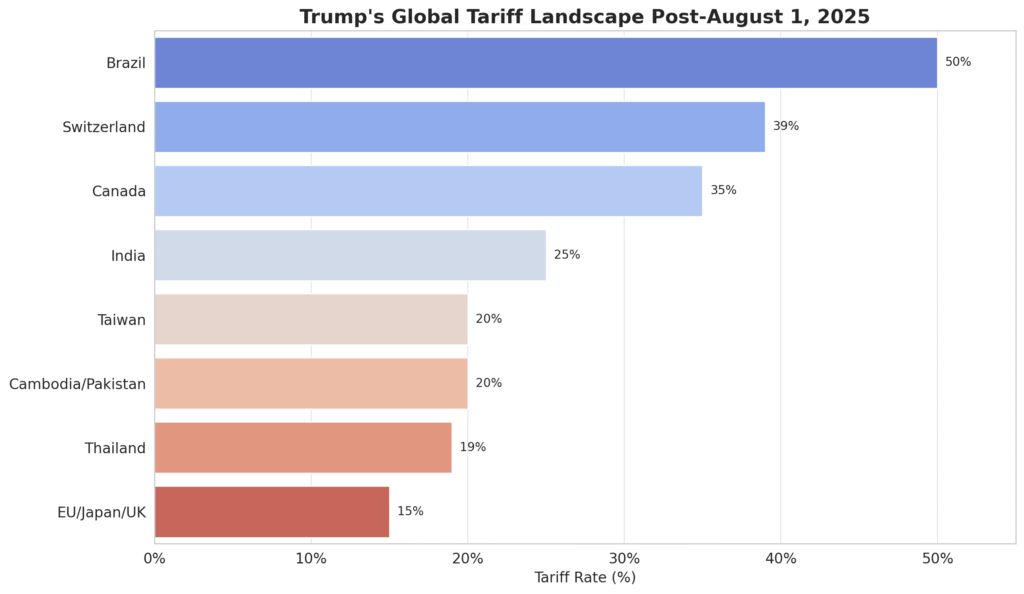
Japan, the United Kingdom, South Korea, and the European Union managed to secure trade frameworks just in time. These agreements generally capped tariffs at 15%, though specific industries saw more favourable terms. In return, the nations pledged increased American imports in agriculture, energy, and aerospace.
“We’ve reached an agreement in principle,” said EU Commissioner Helena Fauth. “This doesn’t mean we endorse the method, but we must shield our industries and workers from unpredictable market chaos.”
Thailand, Cambodia, Pakistan, and Bangladesh took another route: agreeing to increase U.S. imports and open domestic markets to American firms. In exchange, they landed in the 19–20% tariff range, with promises to revisit terms next quarter.
Taiwan, a key semiconductor supplier, settled on a 20% tariff rate with an understanding to reduce over time pending U.S. chip purchase guarantees.
“I believe President Trump is a transactional man,” said Taiwanese trade minister Grace Huang. “So we made a transaction.”
The Defiants – Those Who Missed the Deadline
Others weren’t so lucky—or so willing.
Canada, once one of America’s closest allies, failed to reach any agreement. As of August 1, its exports are slapped with a 35% tariff across multiple sectors, including automotive, lumber, and dairy.
“The American government has weaponized trade diplomacy,” said Canadian Prime Minister Mark Carney. “We will not cave to economic coercion dressed as negotiation.” His remarks were echoed across political lines. Ontario Premier Doug Ford warned of “massive retaliatory duties” on U.S. agricultural goods and pharmaceuticals.
India also missed the deadline, now subject to a 25% blanket tariff. Relations had cooled recently over Delhi’s oil trade with Russia and digital protectionism. “We bent over backward for alignment,” said Indian Commerce Minister Anand Dubey. “Washington moved the goalpost.”
Switzerland now faces a 39% tariff on key exports like luxury watches, medical equipment, and precision tools. A spokesperson from the Swiss Secretariat for Economic Affairs called the move “irrational and legally dubious.”
Brazil, reeling from political infighting and facing a 50% tariff, blamed the impasse on its refusal to drop legal proceedings against ex-president Jair Bolsonaro. “Our judiciary is not for sale,” declared Brazilian Foreign Minister Paulo Tavares.
The Silent Story – Market Anxiety and Domestic Blowback
Amid the geopolitical posturing, a quieter story unfolds at home—and on store shelves.
“The dirty truth,” said Georgetown economist Lena Roy, “is that U.S. consumers will bear the brunt of this. The price of everything from electronics to food is about to jump.”
According to the Peterson Institute, exporters absorb about 20% of tariff costs, meaning 80% typically pass down to U.S. businesses and consumers. Early indicators already suggest inflationary pressure.
U.S. job growth in July slowed to just 73,000 positions, well below expectations. The unemployment rate ticked up to 4.2%. Consumer confidence dipped, and the Dow fell nearly 500 points on August 1.
Meanwhile, a cultural rebellion brews in Canada. Coffee shops in Toronto and Montreal began renaming “Americanos” as “Canadianos.” Social media hashtags like #MapleOverTrump and #TariffRevenge trended throughout the day.
Back in Washington, not everyone is aligned with the White House.
“This isn’t trade policy. It’s economic trench warfare,” said Senator Jon Tester (D-MT), joining a bipartisan group calling for judicial review. Indeed, a recent court ruling (V.O.S. Selections v. Trump) determined that a previous set of emergency tariffs had overstepped executive authority. Further legal challenges are expected.
Key Takeaways
- Countries that cut deals (EU, UK, Japan, South Korea, Thailand, Taiwan) secured reduced tariffs (~10–20%).
- Canada, India, Brazil, and Switzerland missed the deadline and now face punitive duties (25–50%).
- Markets tumbled and inflation fears rose following the August 1 tariff trigger.
- Public backlash, especially in Canada and India, may worsen diplomatic ties.
- U.S. courts may intervene, challenging the legality of Trump’s global trade remapping.
Questions This Article Answers
- Which countries negotiated with the U.S. before Trump’s August 1 tariff deadline?
- Which nations missed the cutoff—and what tariffs do they now face?
- What are the likely effects on global markets and domestic inflation?
- How are world leaders and citizens reacting to Trump’s trade threat?
- Are there legal risks or domestic opposition to Trump’s strategy?