Related reading: 3 Narratives News | About the Editor | Corrections & Editorial Standards
3 Narratives News | April 1, 2026
By Carlos Taylhardat
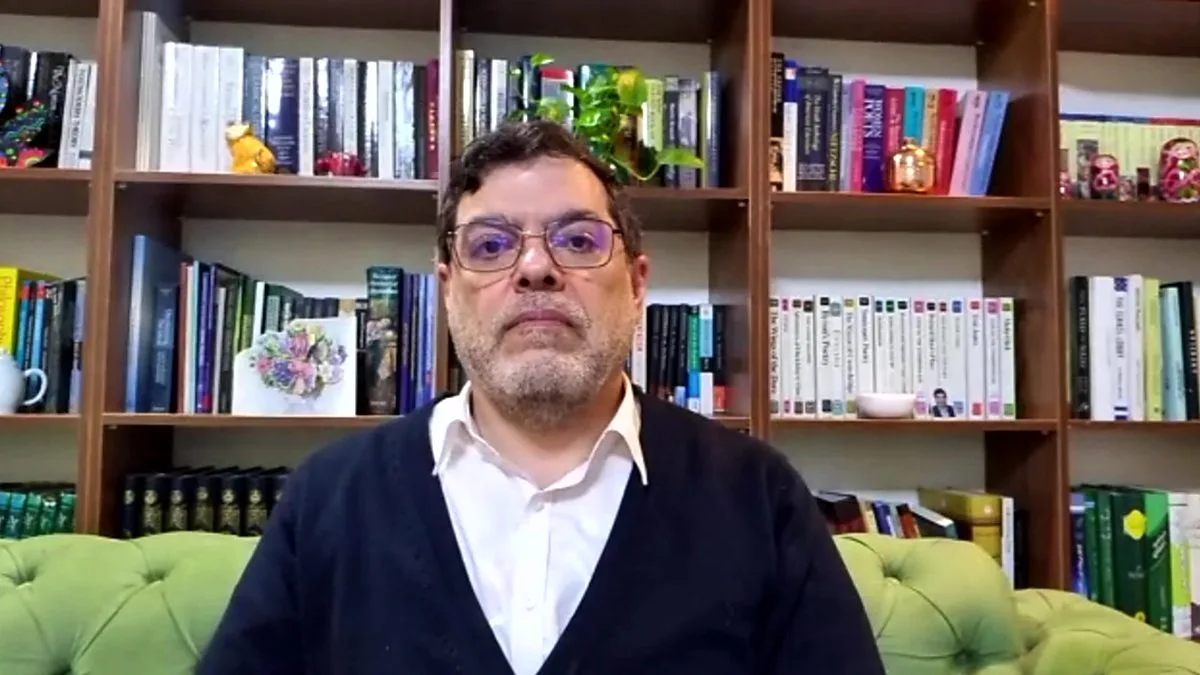
This article examines why Professor Seyed Mohammad Marandi, a University of Tehran academic and former adviser to Iran’s nuclear negotiators, has become one of the most visible English-language unofficial spokespersons for Iran. It also examines why many critics believe that visibility comes with a political cost.
AI disclosure: Research and drafting assistance were used in the preparation of this article. Final framing, analysis, and editorial responsibility remain human.
When a country is under bombardment, there are usually two battles at once. One is fought in the sky. The other is fought in language. In the present war of USA, Israel and Iran, missiles and air defences have drawn the world’s eye, but words have become their own front. Into that front steps Seyed Mohammad Marandi, a professor in Tehran, calm on camera, measured in English, sharp with hostile interviewers, and increasingly familiar to Western audiences who may not trust him, but keep watching him anyway. Now, the translator of Tehran became the West’s most watched adversary.
He is not Iran’s formal foreign minister. He is not, in the strict bureaucratic sense, the official spokesman of the state. Yet in the strange architecture of modern media, where governments speak through diplomats, militias, anchors, academics, exiles, podcasters, and satellite panels all at once, Marandi has become something more ambiguous and perhaps more influential, the unofficial public face through which many English speaking viewers encounter the Iranian position. He speaks both languages fluently and culturally.
That matters because wars are not understood only through troop movements and casualty counts. They are understood through narrators. And in this war, he is Tehran’s most recognizable narrator, a man whose life cuts across worlds, born in the United States, shaped by the Iran-Iraq war, trained in English literature, immersed in debates about Orientalism and Western power, then elevated into the role of televised interpreter of the Islamic Republic’s worldview.
Reader Roadmap
This story asks three different questions at once.
First, why do many in Iran and across the wider anti-intervention camp see Marandi as an indispensable translator, a man who can explain Tehran to a hostile English language media ecosystem without apology.
Second, why do many of his critics see something darker, not a translator but a polished political shield, an academic who gives regime narratives the tone of scholarship and the cadence of reason.
Third, what does his rise reveal about the deeper media vacuum around Iran, a system in which war is increasingly explained to the outside world not by transparent institutions, but by unofficial interpreters who become symbols in their own right.
The Man Behind the Voice
Seyed Mohammad Marandi is a professor at the University of Tehran. His official university profile lists him in the Faculty of Foreign Languages and Literature in Tehran. That is the dry institutional version. The more human version is harder and more revealing.
Marandi was born in Richmond, Virginia, and spent part of his early life in the United States before his family returned to Iran. He later volunteered during the Iran-Iraq war, survived chemical attacks, studied English literature at the University of Tehran, completed doctoral work at the University of Birmingham, and built an academic career examining literature, Orientalism, media framing, and the politics of representation. His published work and public essays show a consistent intellectual preoccupation with how the West describes the non-Western world, how power hides inside language, and how narratives about Iran are constructed before facts are even weighed.
That background helps explain why he does not sound like a conventional state spokesman. He sounds like a literary critic who wandered into geopolitics and never left. He often argues as if media framing is not secondary to war but central to it. For him, the battlefield of description comes before the battlefield of decision. If people can be caricatured, they can be isolated. If they can be isolated, they can be punished. If they can be punished, the punishment can be sold as morality.
It is one reason he has remained visible for so long. As early as 2010, PBS described him as a regular on the international talk show circuit, appearing on major networks in articulate American English while defending positions rooted in Tehran’s worldview. By 2022, the Associated Press referred to him as an adviser to Iran’s indirect nuclear talks in Vienna. Those are not minor footnotes. They help explain why, during the present war, so many interviewers, including YouTube hosts and broadcasters in the West, keep turning back to him. He is legible to them. He can speak in their idiom while refusing their assumptions.
Context: Why He Matters Right Now
In wartime, information narrows. Governments censor. Military realities move faster than reporters. Foreign correspondents lose access. Social media fills the void with rage, propaganda, rumor, and staged certainty. In those moments, a figure like Marandi becomes unusually valuable to the global media machine, not because he is neutral, but because he is available, articulate, and connected to the worldview of power in Tehran.
That is a subtle but essential distinction. Marandi matters not because he floats above the conflict, but because he stands clearly inside one side of it while speaking in a language the other side understands. For producers and hosts, that makes him bookable. For audiences, that makes him decipherable. For supporters in Iran and beyond, that makes him useful. For critics, that makes him dangerous.
His public profile also fits the age. The old model of geopolitical expertise, former officials in suits speaking in carefully disinfected phrases, has given way to something more direct and more combustible. Today, a professor in Tehran can debate a British broadcaster, appear on a podcast hours later, then circulate in clipped fragments across X, YouTube, Telegram, and Instagram before midnight. In that world, Marandi is not simply a guest. He is a recurring node in the war’s information network.
Narrative 1: To His Supporters, He Is Tehran’s Most Effective Translator

From this perspective, Seyed Mohammad Marandi matters because he does what few others in Tehran can do with such fluency. He translates an Iranian national security worldview into polished English without surrendering its emotional core. That is not a small talent. It means he can sit before skeptical Western hosts and speak from inside the historical memory that shapes Iranian thinking, the memory of foreign intervention, sanctions, chemical warfare, regional encirclement, and repeated efforts to isolate the Islamic Republic until it breaks.
His supporters would say the Western press often interviews Iranians only when they confirm Western expectations. The acceptable Iranian is the dissident who condemns Tehran in familiar language, or the exile who narrates the country as permanent darkness. Marandi breaks that script. He does not arrive to reassure the West. He arrives to confront it. He argues that Iran sees itself not as the irrational aggressor of Western caricature, but as a country that has endured decades of coercion while being lectured by states that invaded Iraq, shattered Libya, armed regional wars, and then claimed the monopoly on civilization.
That is why many of his appearances feel less like standard television debates and more like courtroom reversals. He tries to put the interviewer, and by extension the Western political class, on trial. When he debates figures such as Piers Morgan, what supporters admire is not merely his sharpness. It is his refusal to grant the premise that the West is the natural judge and Iran the natural defendant. In their eyes, he is valuable precisely because he unsettles that hierarchy.
Supporters also point to his biography as proof that he speaks from experience rather than abstraction. He is not a man who learned war in seminar rooms alone. He lived through the Iran-Iraq war and its chemical horrors. He later studied the language and literature of the very powers that now dominate global discourse about his country. To admirers, that combination is potent. He knows Western vocabulary, but he also knows what it misses.
Seen this way, his importance to the media is obvious. He offers Western audiences something rare, an Iranian voice that does not arrive filtered through apology. Even when viewers reject his conclusions, they hear a worldview that official Western briefings often flatten or erase. In a war full of simplifications, his supporters believe he restores historical depth.
Narrative 2: To His Critics, He Is Not a Translator but a Polished Regime Surrogate

From the opposing view, Marandi’s skill is precisely the problem. Critics do not deny that he is articulate, educated, or media savvy. They argue that those strengths make him more effective at legitimizing power, not more trustworthy. In their telling, he does not merely explain the Iranian position. He sanitizes it.
This critique is not fringe. Iran International has described him as a mouthpiece, and IranWire has cast him as one of the Islamic Republic’s strongest defenders in English-language media. Critics note that he has been close enough to serious diplomatic processes to serve as an adviser around nuclear negotiations, and visible enough in international broadcasting to function, in practice, as a trusted public defender of the establishment. To them, that is not independent analysis. It is ideological service performed with academic polish.
They would also say that his method relies on a familiar maneuver, turn every challenge into a charge of Western hypocrisy, then use that hypocrisy to avoid direct moral reckoning with the Islamic Republic itself. Does the West have a long record of violence, intervention, and double standards? Of course. But critics argue that Marandi uses those truths as a shield against questions about state repression, imprisoned dissidents, executions, media control, and the rights of Iranians who do not share the regime’s view of resistance.
From this perspective, his debates with Western hosts can look impressive while still being evasive. He may win the clip, but lose the country. He may expose shallow journalism, yet still leave viewers with a filtered picture of a state that punishes internal dissent much more harshly than his television style suggests. Critics believe his calmness can become camouflage, turning a hard system into an argument about nuance.
And so his media importance becomes, in this reading, a warning rather than an achievement. The danger is not that he is crude propaganda. The danger is that he is sophisticated propaganda, the kind that borrows the prestige of scholarship, the pain of biography, and the rhythm of literary criticism to make power sound reasonable.
3N Diplomatic Lens
What makes Marandi such a compelling figure is that both sides are responding to something real. He is plainly more than a random television pundit. His academic record, diplomatic adjacency, and long media footprint give him real standing. But standing is not the same as neutrality. The deeper question is not whether he is eloquent. He is. The question is what eloquence does during war, whether it clarifies a nation’s fear, or launders a state’s violence, or somehow does both at once depending on who is listening.
Perspective: The Third Narrative
The overlooked story is not only about Marandi. It is about the media ecosystem that made him necessary.
When countries become opaque, whether through censorship, sanctions, war, or mutual demonization, the world starts depending on unofficial interpreters. These figures emerge in the gap between governments and publics. They are not formal spokesmen, yet they become recognizable embodiments of a national line. They are not neutral analysts, yet they become indispensable because the normal channels of understanding have broken down.
That is why Marandi matters beyond his own views. He is a symptom of information scarcity. He rises because there are so few trusted bridges between Tehran and the West. Official Iranian statements are often too rigid to persuade. Western coverage is often too shallow or too ideological to convince. Into that fracture steps the professor who can debate, provoke, contextualize, accuse, and humanize, sometimes all in the same segment.
The tragedy is that war rewards exactly this kind of figure. Not because war loves truth, but because war punishes complexity and then sells the survivors as clarity. Marandi survives on screen because he is not simple, but he is forceful. Viewers who fear Iran watch him to decode threat. Viewers who sympathize with Iran watch him to hear defiance. Viewers who distrust everyone watch him because he seems, at the very least, to reveal what one side actually believes.
That may be his deepest importance to media. He is not merely telling the story. He is showing how broken the storytelling has become.
Why This Story Matters
To understand a war, it is not enough to know who launched which strike or which corridor may close next. We also need to know who gets to explain a country to the outside world when the bombs are falling. Right now, for many outside Iran, that figure is Seyed Mohammad Marandi.
Some will see him as a truth teller from a besieged capital. Others will see him as a disciplined defender of an authoritarian state. Both readings contain part of the answer. The fuller truth is that Marandi has become important because the world keeps reaching for him whenever it wants Tehran translated into English, and because in moments of fear, the translator can become almost as consequential as the event itself.
That is a strange kind of power. Not the power to command an army, but the power to shape how an army is understood. In modern war, that may be one of the most consequential powers of all.
Key Takeaways
- Seyed Mohammad Marandi is a University of Tehran professor whose English language media presence has made him one of the most recognizable interpreters of Tehran’s wartime position.
- His background blends war experience, academic work on Orientalism and media representation, and proximity to Iranian diplomacy.
- Supporters see him as an essential translator of Iran to a hostile Western media system.
- Critics see him as a polished defender of the Islamic Republic who gives state narratives academic legitimacy.
- His rise reveals a deeper crisis, the lack of trusted, transparent channels through which Iran and the West can understand one another.
Questions This Article Answers
- Who is Seyed Mohammad Marandi?
- Why does Professor Marandi appear so often in Western media?
- What are Seyed Mohammad Marandi’s academic credentials?
- Why do critics call Mohammad Marandi a regime spokesman?
- Why has Marandi become important during the war around Tehran?
FAQ
Who is Seyed Mohammad Marandi?
He is a professor at the University of Tehran, a public commentator on Iran and geopolitics, and a former adviser connected to Iran’s nuclear negotiations.
Why is Mohammad Marandi important to Western media?
Because he can explain Tehran’s worldview in fluent English, in real time, during moments when access to Iranian official thinking is limited.
Is Seyed Mohammad Marandi an official spokesman for Iran?
No formal public title makes him the sole spokesman of the Iranian state. But he often functions as an unofficial public interpreter of Tehran’s position.
What does Marandi stand for?
His public arguments consistently emphasize anti interventionism, criticism of Western power, defense of Iranian sovereignty, and suspicion toward how Western media frames Iran and the wider region.
Why is he controversial?
Because supporters see him as an honest translator of Iran’s position, while critics see him as a highly effective defender of the Islamic Republic and its policies.
External sources: University of Tehran profile | Associated Press reporting on the Vienna talks | Al Jazeera author page


