
A neighborly wish becomes a tiny political test. One side hears warmth and tradition, the other hears assumption and erasure. The silent story lives in a place where men once stopped shooting long enough to remember they were human.
3 Narratives News | December 25, 2025
Intro
It happens in the smallest moments, the kind you barely notice until you do. A cashier hands you a receipt and says,
“Merry Christmas.”
A neighbor calls from the porch, “Merry Christmas, Carlos.” A colleague signs off an email with “Xmas,” and suddenly the word looks sharper than it should, like someone set it down too hard.
The phrase is meant to be a gift. Most of the time, it lands that way. But every year, in certain rooms and certain timelines, the greeting turns into a referendum. Who belongs, who does not, and who gets to decide what a holiday “really” is?
So today, we’re going to contemplate the question that sounds silly until it becomes personal: who gets insulted by a “Merry Christmas” or “Xmas” wish, and why does it feel like the stakes keep rising?
Context: A Greeting That Carries More Than It Should
In North America, Christmas has two lives at once. One is explicitly Christian, a holy day commemorating the birth of Jesus, shaped by liturgy, scripture, and the long shadow of faith. The other is modern, civic, commercial, and often family-centred, a season of lights, food, generosity, and reunions, sometimes practiced with little or no religious content at all.
That tension is not new. What is new is how quickly it escalates. In public, the greeting becomes a proxy war over inclusion, tradition, assimilation, and power. In private, it becomes something much simpler: what did you mean, and how did I hear it?
Even surveys hint at the mismatch between the online argument and the lived reality. In one Pew Research Center poll about how stores should greet customers, a large chunk of people preferred “Merry Christmas,” but almost as many said it did not matter. The public argument is loud. The private experience is often softer, more forgiving, more human.
And then there’s the little match that keeps getting lit: “Xmas.” Some people see it as taking Christ out of Christmas, a secular insult. Others see it as harmless shorthand. The truth is stranger and older than the fight. “X” has been used as a symbol for Christ because it echoes the Greek letter Chi, the first letter of “Christos.” In other words, “Xmas” is not automatically an attack on Christianity. In many cases, it’s a historical abbreviation that got swept into modern advertising.
So we are left with a question that is not really about letters. It’s about what kind of society we’re trying to be when we speak to each other in passing, and whether we still allow generosity to count for anything.
Related 3N context: We’ve reported on how public squares become battlegrounds when language is treated like a weapon. For a deeper look at the modern incentive structure, see Maria Ressa’s Warning: Disinformation, Democracy, and the Authoritarian Playbook and The Clock Is Ticking: TikTok, Truth, and the Future of Social Media.
Narrative 1: Christmas Is a Festive Time for All
I was raised sort of Catholic in a town called Estoril, about sixteen kilometres north of Lisbon. It was a beautiful place, minutes from the beach, with mild winters and a national character that, in those days, felt deeply rooted in Catholic tradition. Portugal carried a rich history of saints and miracles, the kind of stories that settle into a child’s bones and feel as natural as weather.
As a boy, I assumed this was simply how the world was arranged. Catholic meant good, familiar, safe. Anything else felt foreign, suspicious. One day, my father told me he was an atheist. It shook me. I remember feeling embarrassed, as if I had been handed a secret I did not know how to hold. I went to a priest for advice. In my child’s mind, the conclusion felt obvious and terrifying. If you weren’t Catholic, you were a heathen. I cried. I prayed for God to forgive my father. I wondered, privately, why he would choose exile.
Then I arrived in Canada. I was twelve and I had to learn English. It was not my first new language, but it was the one that made me feel most exposed. It is hard to be intelligent in your own mind and helpless with your mouth. You become cautious. You smile more than you speak. You watch people closely, studying how they belong.
My teacher, Mrs. Kauffman, was the most beautiful teacher I had ever met. Not just in appearance, though she was radiant, but in the way her kindness seemed to glow. She knew how to teach without making you feel small. Her inner wisdom felt bigger than the classroom. Somehow, she understood what it meant to be new, to be silent, to be watching for the rules.
Then, in early December, she showed us a row of candles and told us she did not celebrate Christmas because she wasn’t Christian. She was Jewish. I remember the exact sensation, the internal jolt. I had spent my childhood believing Catholicism was the measure of goodness, and now I was being taught English, and safety, and belonging, by someone outside the boundaries of the world I thought God had drawn.
At night, I cried again. But this time my prayer changed. I asked God to find a place for her in heaven. Then I stopped and realized the problem was not her. The problem was the picture in my head. Why would God punish someone who was so clearly good? That did not make sense to me.
For three nights, I prayed and then did something that, in retrospect, was a small act of rebellion. I started asking her questions. Not to challenge her, but to understand. How did her religion work, and what did it teach about kindness, about family, about dignity? Later, I looked into other religions. Eventually, I reached a quiet conclusion that felt both freeing and sad, like stepping out of a house you loved. Religion, for me, became a flavour. What mattered was whether you were kind. I became agnostic. And I made peace with my father’s atheism.
So now, when I wish someone “Merry Christmas,” what I’m really saying is, love to you. I’m saying, I hope your home is warm. I hope your heart gets a rest. I hope you feel forgiven, and able to forgive. I hope you call your mother. I hope you hug your children, or the people who feel like children in your care. I hope you remember you are not alone.
Is Christmas for Christians only? The roots, undeniably, are Christian. But the branches now reach far beyond the church. Christmas can be sacred and secular at the same time. It can be a day for worship, and a day for family, and a day for those who simply need a reason to be gentle.
So Merry Christmas, and Merry Xmas, to our current readers and future readers. From me, Carlos Taylhardat, editor of 3 Narratives News, our first Christmas edition.
Narrative 2: The Greeting Isn’t the Problem, the Assumption Is
From this view, the debate is not really about whether people should say “Merry Christmas.” It’s about what happens when one identity becomes the default setting of public life.
Imagine you are Jewish, or Muslim, or Sikh, or atheist, or simply someone who has never felt at home inside Christian language. You live in a country where December turns into a long parade of symbols that are not yours. The radio, the office party, the school concert, the store soundtrack, the endless red and green. You don’t hate it. You may even enjoy parts of it. But you notice how quickly the season teaches a quiet lesson: this is what “normal” looks like.
When someone says “Merry Christmas,” most of the time it feels like politeness, and you answer politely. But sometimes, especially when it happens repeatedly, the greeting starts to feel less like a gift and more like a test. Will you play along, will you smile, will you take the role of grateful guest in someone else’s holiday?
It’s not that a non-Christian must feel upset, Side B says. It’s that they shouldn’t have to work to make other people comfortable. And they shouldn’t have to explain themselves in order to receive the same warmth everyone else receives automatically.
In this worldview, “Happy Holidays” is not an attack on Christmas. It is a practical act of hospitality in a plural society. It’s what you say when you don’t know what the other person celebrates, and you want to include them without forcing them to perform gratitude for a tradition that might not be theirs.
And then there’s the workplace layer, the place where the stakes get quietly higher. You may love your colleagues, but you also need your job. So you nod at the Christmas party. You accept the candy canes. You let the decorations surround you. You do not complain. You do not want to be the person who “ruins it.”
Side B also worries about how the greeting debate can become a trap. There are people who do not say “Merry Christmas” as a kindness, but as a provocation. A little flare shot into the air to see who flinches. In those moments, the greeting is no longer a wish. It’s a statement about who holds cultural power, and who is expected to adapt.
So what should a Christmas-celebrating neighbor do if the other neighbor is Jewish? Side B’s answer is not “never say Merry Christmas.” It’s simpler and more human: learn your neighbor. Ask what they celebrate. Ask what matters to them. Use the greeting that fits the relationship. If you don’t know, choose the broader one, not out of fear, but out of courtesy.
Christmas, Side B agrees, has grown into a civic season that many non-Christians participate in, whether they attend parties, exchange gifts, or simply enjoy the cultural warmth. But it is precisely because Christmas is so large that the small gestures matter. When one tradition fills the whole public room, the burden of inclusion quietly shifts onto everyone else.
In this story, a considerate society doesn’t lose Christmas by expanding its language. It gains something else, the simple skill of making room.
The Silent Story: The Day the Trenches Went Quiet
Every argument about Christmas greetings eventually runs into a harder question, what is the season for, if not a pause in the fight?
In December 1914, on parts of the Western Front, something improbable happened. British and German soldiers, frozen and exhausted in trenches carved into mud, edged into no man’s land. They exchanged small gifts and played soccer instead of fighting each other. They took photographs. In some places, they played impromptu football. In others, they buried their dead and repaired what the war had broken, if only for a day.
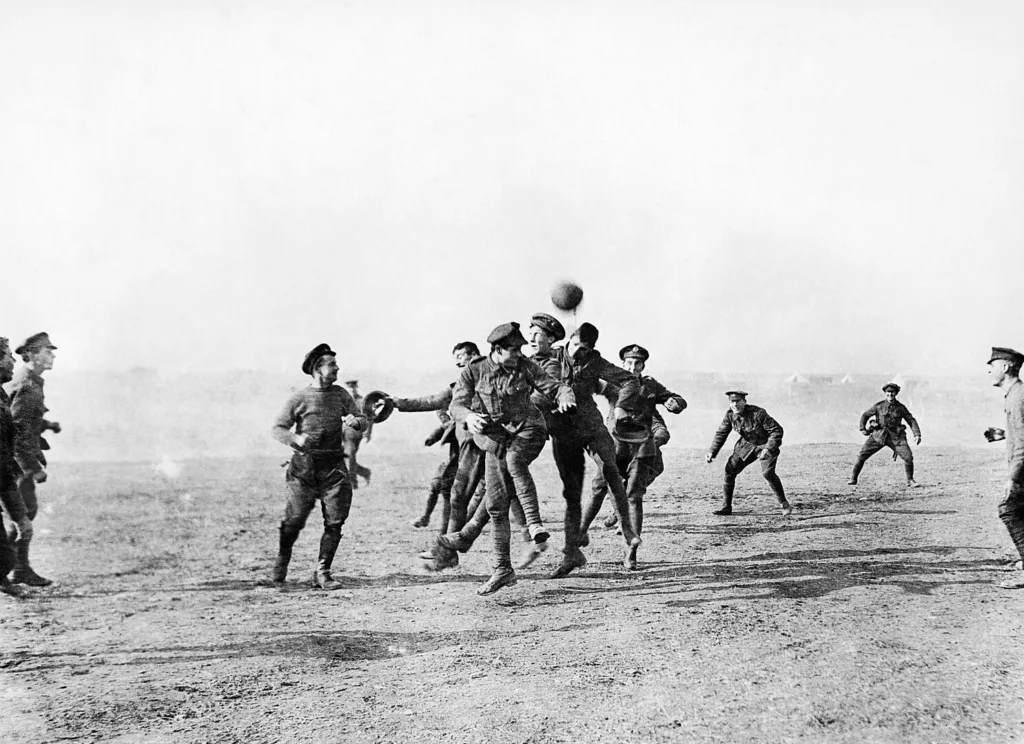
It did not happen everywhere. In many sectors, the war continued, and there were casualties even on Christmas Day. Officers in some units were unhappy with the truce, worried it would soften resolve and undermine the machinery that war requires. And after Boxing Day, meetings dwindled. The guns returned to their work. The spell was broken.
But the meaning of that brief quiet has outlived the tactical reality. For a moment, men trained to kill each other remembered that the enemy had a face, hands, hunger, jokes, and someone waiting at home.
This is the silent story beneath the greeting debate. Christmas, at its best, is not a badge of membership. It is a temporary ceasefire in the war inside us, the war that turns strangers into categories. The season asks, for one day, could you stop firing?
So if your neighbor wishes you “Merry Christmas,” you can take it as it is meant, most of the time, a small candle offered across a fence. And if you choose “Happy Holidays,” you can offer that, too, a wider candle, meant to reach more hands. The better question is not which greeting wins. The better question is whether we can still use any greeting to remember what we owe each other.
My view this year: let’s take a break from war, from disagreement, from the need to be right. Find places to agree. Hug a neighbor. Call a friend. Say one kind word you have been delaying. Merry Christmas, Merry Xmas, and peace to you from the team at 3 Narratives News.
Key Takeaways
- Most people mean “Merry Christmas” as warmth, not as a boundary.
- Some non-Christians feel discomfort when the greeting is treated as a public default rather than a personal wish.
- “Happy Holidays” often functions as a courtesy when you do not know what someone celebrates.
- “Xmas” is widely used as shorthand, and the “X” has a historical connection to the Greek letter Chi used for “Christos.”
- Christmas has strong Christian roots, but in modern life it is also widely practiced as a secular family holiday by Christians and non-Christians alike.
- The silent story is the human one: the season is at its best when it lowers the temperature, even briefly.
Questions This Article Answers
Who is most likely to feel uncomfortable with “Merry Christmas”?
Usually not someone who hears it as a personal wish, but someone who experiences it as a public default that assumes a shared faith or shared tradition.
Is it rude to say “Merry Christmas” to a non-Christian?
Not automatically. If it is offered with genuine warmth, most people take it that way. When in doubt, or in professional settings, “Happy Holidays” can be an inclusive alternative.
Is Christmas only for Christians?
Its origins are Christian, but in the modern era it is also widely observed as a secular family holiday by Christians and non-Christians alike, especially in North America.
Does “Xmas” remove Christ from Christmas?
Not necessarily. “X” has long been used as an abbreviation for Christ, connected to the Greek letter Chi in “Christos,” though many people still dislike the shorthand for cultural reasons.
What does the 1914 Christmas Truce teach us about the season?
It suggests the season’s deepest power is not performance but pause, the ability, even briefly, to stop treating other humans as enemies.
External Sources (For Readers)
For readers who want the history behind the language and the truce: Pew Research Center on holiday greetings, Encyclopaedia Britannica on Christmas as both religious and secular, Merriam-Webster on “Xmas”, and Imperial War Museums on the 1914 Christmas Truce.