Related reading (3N Iran file):
Iran Protests, Rial Collapse, Bazaar Strikes (2026) |
Eyewitness accounts describe live fire and an internet blackout. Washington hints at “strong options.” Tehran says it will not back down. Between them sits a question that matters far beyond Iran: when a state cracks, what replaces it?
3 Narratives News | January 12, 2026
On the phone, the voice described something simple and terrifying: a crowd, a line of security forces, and the sudden feeling that words were no longer considered language.
In the BBC account shared with us, a protester the network calls “Omid” says security forces
“fired directly into lines of protesters,”
and then adds a sentence that reads like a country’s last diary entry: “We are fighting a brutal regime with empty hands.”
Verification is harder than usual. Iran’s authorities have repeatedly restricted access to the internet in moments of unrest, and rights groups say the most recent shutdown has been broad. Amnesty International says an internet blackout is concealing violations and is itself a rights violation, while Human Rights Watch describes lethal force and mass detentions since protests began on December 28, 2025. (Amnesty | HRW)
What’s happening now, and why it matters
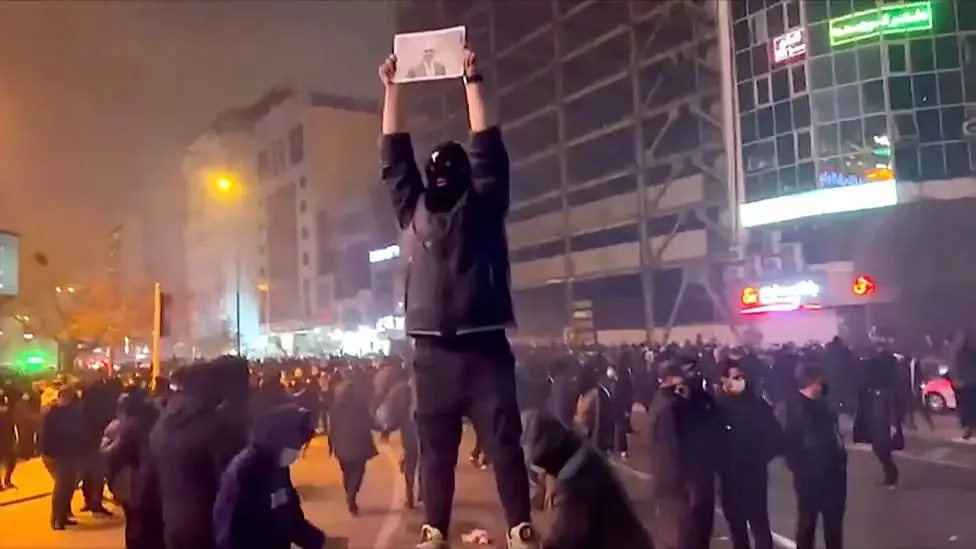
Multiple outlets and monitors describe the same outline: unrest that widened quickly, a heavy crackdown, and a communications blackout that turns reporting into triangulation. Reuters reports that the U.S.-based rights group HRANA has documented hundreds of deaths and more than 10,000 arrests, figures Reuters says it cannot independently verify in full, while Iranian officials have blamed foreign adversaries and framed protest activity as “terrorism.” (Reuters)
NetBlocks, which tracks internet disruptions globally, has reported Iran’s national connectivity falling to a small fraction of normal levels during the blackout. (NetBlocks)
What matters to the global order is not only the suffering inside Iran. It is the precedent. Iran is a major regional power. If it enters a spiral, the effects do not stop at its borders. Energy markets, shipping routes, refugee corridors, and regional security arrangements all begin to wobble.
But the comparison to intervention in Venezuela in Iran is in many people’s minds, will the USA use the Delta Force and force regime change, arrest Iranian leaders? (UNHCR) So in our first Narrative, we compare a possible outcome like Venezuela, although this is a very new event that is barely a week old, but when we say like Venezuela, we mean USA intervention.
How much support does the Iranian government really have?
In an environment where independent polling can be difficult and sometimes dangerous, numbers come with caveats. Still, one of the most cited recent sources is GAMAAN (The Group for Analyzing and Measuring Attitudes in Iran), which runs large online surveys designed for restrictive environments.
In its analytical report based on a June 2024 survey, GAMAAN reports that around 70% of respondents oppose the continuation of the Islamic Republic, while only about 20% support continuing it, and the remainder are uncertain or prefer not to choose. GAMAAN also reports that 89% support democracy as a principle. (GAMAAN summary | Full report (PDF))
Important limitation: Online surveys can be skewed by who has access, who feels safe responding, and who chooses to participate. These findings should be treated as indicative, not absolute. But the consistency across multiple iterations suggests a political problem for Tehran that is structural, not seasonal.
Narrative 1 (Side A): Yes, Iran can end up like Venezuela
Side A begins with a bleak proposition: Iran is entering the same tunnel Venezuela entered years ago, where the destination is not a clean “regime change” moment, but permanent national exhaustion.
In this worldview, the decisive weapon is not a missile. It is the combination of currency collapse, institutional decay, and the slow departure of the country’s most mobile citizens. Venezuela’s story is a warning label: once a nation falls into prolonged economic depression, talent flight accelerates, the state becomes more dependent on coercion, and the opposition becomes more symbolic than operational. Iran is following the same pattern.
The Iranian version of that tunnel has three features.
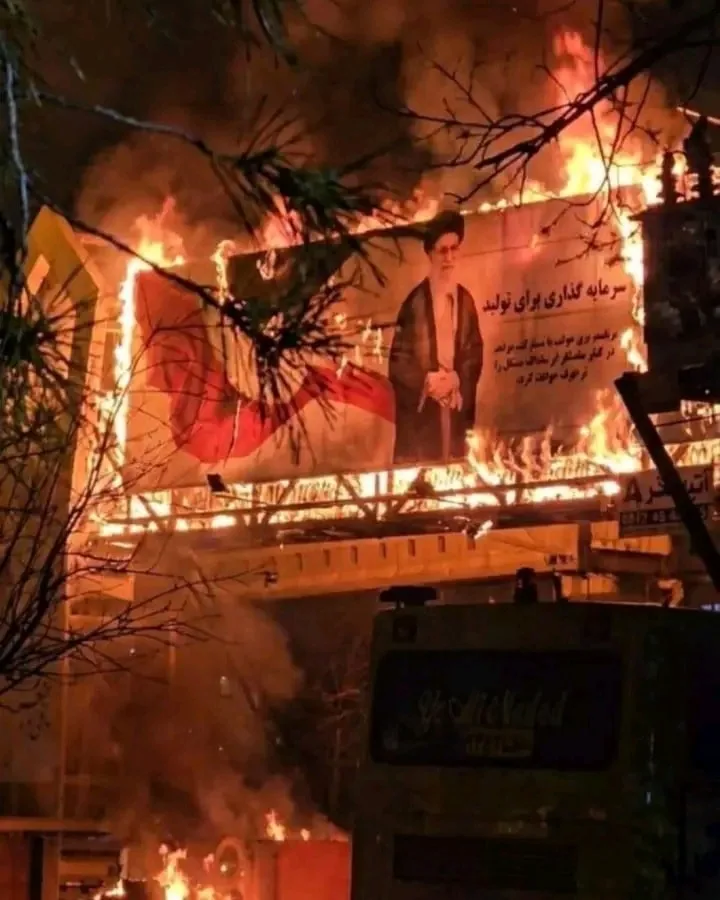
1) The economy is becoming the regime’s worst enemy
Side A reads the protests as a referendum conducted in bread lines, rent checks, and pharmacy queues. Human Rights Watch describes protests escalating alongside lethal force and mass detentions, and Amnesty describes an “escalating deadly crackdown.” Side A’s point is that when daily life becomes humiliating, legitimacy stops being philosophical and becomes arithmetic. (HRW | Amnesty)
Venezuela’s collapse produced a vast diaspora. UNHCR says nearly 7.9 million people have left. Side A argues Iran is vulnerable to a comparable long-haul story: a widening gap between the governed and the governing, and a slow-motion exit of the people most able to leave.
2) Crackdowns can “work” tactically while failing strategically
Side A does not treat street control as victory. It treats it as a loan taken out against the future. Reuters reports HRANA’s tallies of deaths and arrests, and notes the limits of independent verification under blackout conditions. Side A’s point is not the exact count. It is the governing logic: when the state answers mass grievance with mass force, it may clear streets for a night, but it clears loyalty for a generation.
Amnesty and HRW both describe unlawful use of force and firearms. Side A reads this as an inflection point. Venezuela’s security state hardened over time, and once hardening becomes the system’s main competence, reform becomes nearly impossible without a rupture. (HRW)
3) The United States becomes a gravitational force again
Side A does not assume an American invasion. It assumes a familiar spectrum of pressure: sanctions, covert support, cyber measures, and “maximum leverage.” Reuters reports President Donald Trump warning Iran and describing “very strong options.”
But Side A says the real accelerant is history: Washington has already shown it is willing to hit Iran directly when it believes the moment demands it.
- The assassination precedent (2020): In January 2020, the U.S. Department of Defense announced that the U.S. military killed Qasem Soleimani, commander of Iran’s Quds Force, in what it described as “defensive action,” ordered by President Trump. Side A treats this as the proof that red lines can be enforced with sudden force, not just diplomacy.
- The “recent war” precedent (2025): In 2025, Israel and Iran entered a direct air war. Reuters reports that during that conflict U.S. forces struck three Iranian nuclear sites, a step that made American involvement explicit rather than implied. Side A reads this as confirmation that
- The coalition-defense precedent (April 2024): Even before the 2025 strikes, U.S. forces were publicly described as helping intercept Iranian drones and missiles aimed at Israel during Iran’s large-scale attack, according to a Defense Department briefing summary. Side A argues that once defense becomes routine, offence becomes easier to justify as the next step.
Here, the Venezuela analogy sharpens. Pressure from Washington can intensify a government’s paranoia and radicalize internal politics. It can also fracture elites, especially if they begin to believe the future will be negotiated with Washington rather than decided in Tehran.
Side A’s bottom line: Iran does not need to become Syria to become what we call like Venezuela. It can remain formally intact, but the government will be bruised and forced to negotiate changes with the USA and trade to cover the expense of intervention, as Trump famously did to Venezuela and Ukraine.
Narrative 2 (Side B): No, Iran is not Venezuela, and it won’t end the same way
Side B begins with an objection that sounds almost cold: Venezuela is the wrong comparison because Iran is built differently, fights differently, and believes differently.
Iran’s system is not only patronage. It is an identity project anchored in institutions designed for survival, including the Islamic Revolutionary Guard Corps, layered internal security, and a governing ideology that treats defiance as virtue. Side B argues that the very things critics call repression are, in Tehran’s internal logic, the tools that prevent collapse.
In this worldview, what looks like fragility is actually calibration.
1) The regime sees unrest as warfare, not politics
Side B leans on doctrine. It reads Tehran’s public statements as a form of strategic messaging: deter foreign escalation, isolate protesters, and define the conflict as sovereignty versus sabotage. Reuters reports Iranian officials blaming foreign adversaries and warning against intervention. (Reuters)
That mindset can be morally disastrous. It can also be strategically stabilizing, because it narrows the regime’s choices to one: survive.
2) Iran’s society is not a blank slate for outside “restoration”
Side B emphasizes culture, not as stereotype, but as political infrastructure. Iran is a society with a long civilizational memory, and a modern tradition of education, science, and statecraft that long predates the Islamic Republic. Side B argues that even many Iranians who reject the current government may still reject an American hand on the steering wheel, particularly if foreign involvement becomes visible enough to feel like humiliation.
3) America’s recent track record cuts both ways
Side B acknowledges that Washington has demonstrated operational reach, including the 2020 strike that killed Qasem Soleimani. The U.S. Department of Defense publicly announced the action, and the Congressional Research Service documented the episode and its legal and strategic controversy. (U.S. DoD statement | CRS (PDF))
Side B argues that this history does not make capitulation more likely. It makes escalation more dangerous. Unlike Venezuela, Iran has a capacity for asymmetric retaliation and a regional network that can respond indirectly. That reality forces Washington into caution, even if rhetoric sounds maximalist.
Side B’s bottom line: Iran may suffer, protest, and repress, but it is more likely to endure than to topple. If change comes, Side B expects it to come through internal fracture and negotiated evolution, not a Venezuela-style slow bleed under sanctions and stalemate.
The 3N Diplomatic Lens
I lived in the Middle East long enough to learn the difference between a country that is merely under stress and a country that is historically trained for it. In Lebanon, I saw sophistication living beside instability, a kind of social intelligence that adapts faster than institutions can collapse. Iran has its own version of that: a long memory, a tradition of scholarship, and an ability to absorb shock without losing the idea of itself.
Diplomatically, this matters because foreign powers often confuse street footage for state failure. They mistake anger for surrender. They read an internet blackout as weakness, when it may be the opposite: a regime’s determination to control the narrative space where revolutions are now organized.
The questions that decide whether Iran becomes Venezuela
Rather than a tidy conclusion, Iran offers a set of questions that will shape everything that follows, including whether the Venezuela analogy becomes prophecy or distraction.
- Can a government “win” the streets and still lose the country? Venezuela suggests yes: a regime can outlast demonstrations while the nation slowly departs.
- Does cutting the internet stop a revolution, or postpone it? NetBlocks and rights groups describe disruptions. The tactical effect is real. The long-term effect is unknown. (NetBlocks)
- What do Iran’s own numbers mean when measured in fear? GAMAAN’s survey reporting suggests minority support for continuation of the Islamic Republic, but measurement in restrictive environments is always imperfect. (GAMAAN)
- If Washington escalates, does it help protesters or help Tehran? Heavy U.S. involvement could validate Tehran’s narrative of foreign interference, even for citizens who despise the regime. (Reuters)
- What does “change” actually look like? Venezuela shows that removing a person does not remove a system. If Iran changes, will institutions change too, or will uniforms and slogans simply rotate?
Key Takeaways
- Eyewitness accounts describe live fire and fear, while reporting is complicated by an internet blackout. (Amnesty)
- Rights groups and wire reporting describe mass arrests and a rising death toll, though comprehensive independent verification is difficult during shutdown conditions. (Reuters)
- Polling is constrained, but GAMAAN reports around 70% oppose continuing the Islamic Republic and about 20% support continuing it. (GAMAAN)
- The Venezuela analogy is less about invasion and more about long-term economic collapse, diaspora, and regime survival. UNHCR estimates nearly 7.9 million Venezuelans have left. (UNHCR)
- The Iran counterargument is that ideology, security architecture, and regional deterrence can make collapse less likely and escalation more dangerous. (CRS (PDF))
Questions This Article Answers
- What triggered the new protests in Iran? Reporting from rights groups and wire services links protests to worsening economic conditions and broader political grievances, followed by a heavy security crackdown. (HRW)
- How many Iranians support the current government under the Supreme Leader? Independent measurement is difficult. GAMAAN’s reporting based on a June 2024 survey found around 70% oppose continuation of the Islamic Republic and about 20% support it, with the remainder uncertain or not choosing. (GAMAAN)
- Could Iran see a Venezuela-style outcome? One scenario is sustained economic decline, mass emigration, and a regime that survives through coercion, a slow collapse rather than a sudden coup. (UNHCR)
- What does U.S. involvement look like historically? The U.S. has shown operational reach, including the 2020 strike on Qasem Soleimani, documented by the DoD and CRS, but that reach can increase escalation risk. (DoD | CRS)
- Why might Iran not follow Venezuela? Iran’s security architecture, ideological cohesion, and regional deterrence may make collapse less likely and foreign intervention far riskier. (Reuters)